Sensor Control Module in Kuwait | Control Module Supplier Qatar
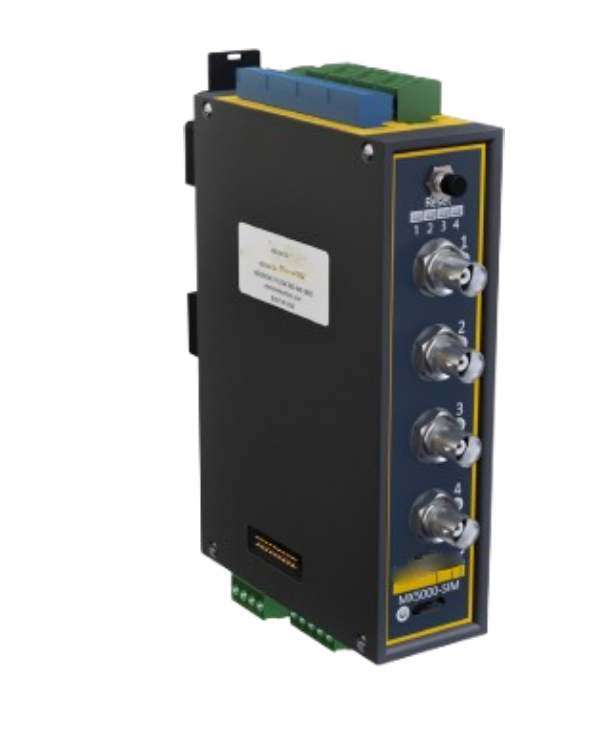
The MX5000-SIM ATEX Sensor Interface Control Module is a smart vibration signal conditioner and machinery-monitoring module designed for industrial rotating and reciprocating equipment. As a dependable Sensor Control Module in Kuwait, it connects vibration and process sensors with PLC, DCS, shutdown, alarm, and condition-monitoring systems.
The module accepts signals from velocity sensors, accelerometers, proximity probe systems, and 4–20 mA process sensors. Each MX5000-SIM supports up to four independent configurable channels, allowing several machinery measurements to be handled through one compact DIN-rail device.
The module provides a 4–20 mA proportional output, buffered dynamic signal, Modbus RS-485 communication, four configurable solid-state relays, sensor diagnostics, alarm indication, and redundant power capability. Multiple SIM modules can also be connected together to create monitoring systems with up to 24 channels.
Hazardous-area versions support ATEX, IECEx, UKEX, Class I Division 2, and Zone 2 applications. The international hazardous-area marking includes Ex ec nC IIC T4 Gc, with an ambient range from −40°C to +85°C.
Atex Hub supplies ATEX Sensor Control Modules across Kuwait City, Ahmadi, Shuaiba, Mina Al Ahmadi, Al Zour, Jahra, Hawalli, and throughout Kuwait, as well as the UAE, Saudi Arabia, Qatar, Oman, Bahrain, Europe, Africa, and worldwide.
What Is the MX5000-SIM Sensor Interface Control Module?
The MX5000-SIM is a DIN-rail mounted smart signal-conditioning and machinery-monitoring module developed for vibration, position, speed, impact, and process-variable measurement.
It receives a raw signal from the connected field sensor, conditions that signal, calculates the selected machinery variable, and transfers the result to plant automation or protection systems.
Typical sensor connections include:
- Velocity and accelerometer sensors: Supports casing-mounted velocity transducers and accelerometers for monitoring vibration on pumps, motors, compressors, turbines, generators, and similar rotating machinery.
- Proximity probe systems: Accepts shaft-observing proximity signals for radial vibration, axial position, shaft position, rod drop, and other displacement-related measurements.
- 4–20 mA process sensors: Accepts standard process-variable transmitters so non-vibration measurements can also enter the machinery-monitoring system.
- Multi-variable sensor processing: A single input can generate more than one calculated measurement through Modbus, such as acceleration with integrated velocity or proximity position with vibration.
The module can operate independently or become part of the wider MX5000 Vibration Monitoring System.
Key Features of the Sensor Control Module
The Sensor Control Module in Kuwait combines sensor conditioning, industrial outputs, machinery alarms, diagnostics, and hazardous-area capability.
- Four configurable monitoring channels: Each MX5000-SIM accepts up to four independent sensor channels, while several SIM modules can be stacked to expand the installation to as many as 24 monitoring channels.
- Multiple sensor technologies: Supports accelerometers, velocity sensors, proximity probes, and 4–20 mA process transmitters, allowing one platform to handle several machinery-monitoring requirements.
- Multiple industrial outputs: Provides 4–20 mA proportional outputs, buffered dynamic outputs, and Modbus RS-485 communication for PLC, DCS, condition-monitoring, and data-analysis systems.
- Integrated relay protection: Four configurable solid-state relays support AND/OR alarm logic, Alert and Danger conditions, and machinery protection functions.
- Sensor and cable diagnostics: Each channel continuously monitors sensor integrity; a failed sensor changes the channel status indication and drives the current output below 3.6 mA.
- Redundant power capability: Operates from 20–30 VDC, while systems with multiple SIM modules can use redundant power supplies for greater monitoring availability.
- Wide operating temperature: Supports industrial environments from approximately −40°C to +85°C.
- Hazardous-area approval: ATEX/IECEx configurations support Zone 2 installations with Ex ec nC IIC T4 Gc protection.
How Does the MX5000-SIM Work?
The module conditions and processes sensor signals before passing them to machinery protection and control systems.
The operating sequence includes:
- A velocity sensor, accelerometer, proximity system, or 4–20 mA sensor connects to one of the four input channels.
- The module supplies sensor excitation when the selected sensor technology requires it.
- The incoming signal passes through the internal signal-conditioning circuit.
- Configurable scaling and filters process the signal according to the selected machinery measurement.
- The module calculates the monitored variable.
- A 4–20 mA output represents the measured value.
- The buffered dynamic signal remains available for waveform analysis.
- Modbus RS-485 transfers measured values, channel status, and selected diagnostic data.
- Alert and Danger levels are compared against configured thresholds.
- The solid-state relays activate according to the selected alarm and voting logic.
- Channel LEDs indicate normal operation, alarm status, or sensor/cable failure.
This structure allows one module to perform signal conditioning, machinery monitoring, alarm processing, and industrial communication.
Supported Sensor Inputs
The MX5000-SIM supports several sensor technologies within the same platform.
| Sensor Input | Typical Use |
|---|
| Velocity Sensor | Machinery casing vibration |
| Accelerometer | Acceleration, impact, and integrated velocity |
| Proximity Probe | Shaft vibration, position, thrust, and rod drop |
| 4–20 mA Sensor | Process variables and external transmitter inputs |
Input signal levels include approximately 100–500 mV/ips for velocity, 10–500 mV/g for accelerometers, 100–200 mV/mil for proximity systems, and standard 4–20 mA process inputs.
Machinery Measurements
The MX5000-SIM supports a wide range of rotating and reciprocating machinery measurements.
- Shaft vibration and position: Supports shaft-relative radial vibration, axial thrust position, and proximity-based displacement measurements.
- Casing vibration: Measures radial or axial machine casing vibration from accelerometers or velocity sensors.
- Reciprocating compressor monitoring: Supports rod drop, rod position, crosshead acceleration, machine impact, and frame vibration.
- Rotational monitoring: Supports shaft rotational-speed measurement through suitable sensor configurations.
- Process-variable monitoring: Accepts 4–20 mA transmitters for pressure, temperature, flow, or other process data relevant to machinery condition.
- Dual-path processing: One sensor input can generate multiple calculated outputs through Modbus, reducing the need for separate sensing channels.
Outputs and Communication
The module provides several output methods for plant integration and detailed vibration analysis.
- 4–20 mA recorder output: Each channel provides one proportional current output suitable for PLC, DCS, recorder, and shutdown-system inputs.
- Dynamic signal output: Each channel provides a buffered raw dynamic signal through BNC and terminal connections for portable vibration analysis or permanent monitoring equipment.
- Modbus RS-485 communication: Transfers measurement values, status information, and selected diagnostic variables to plant automation and monitoring software.
- Redundant Modbus capability: Systems using two or more SIM modules can support redundant Modbus communication arrangements.
- NAMUR-compatible fault behaviour: A sensor failure drives the corresponding output below 3.6 mA, making the fault distinguishable from a valid process measurement.
Alarm and Relay Functions
The MX5000-SIM includes four solid-state relays for machinery alarm and protection logic.
- Four configurable relays: Each relay can respond to selected channel Alert or Danger states.
- AND/OR voting logic: Relay logic can combine multiple channel conditions for machinery shutdown, alarm, or interlock applications.
- Configurable NO/NC operation: Solid-state relay behavior can be configured according to the required fail-safe philosophy.
- Default alarm levels: Typical factory relay defaults are set near 25% and 50% of full-scale range, with approximately three-second delays, while final settings can be configured for the actual application.
- Local relay indication: Dedicated LEDs display relay status during operation, testing, and commissioning.
Applications of the Hazardous Area Sensor Control Module
The Hazardous Area Sensor Control Module supports machinery-monitoring and protection duties across industrial plants.
- Centrifugal compressors: Monitors shaft vibration, axial position, casing vibration, and machine-condition variables.
- Motors and generators: Supports casing vibration, acceleration, bearing-related monitoring, and machinery alarms.
- Process pumps: Detects changes in vibration associated with imbalance, misalignment, looseness, bearing wear, or hydraulic problems.
- Gas turbines: Supports proximity, seismic vibration, and machinery protection measurements.
- Natural gas and diesel engines: Monitors vibration and impact on reciprocating and rotating components.
- Reciprocating compressors: Supports rod drop, rod position, crosshead acceleration, frame vibration, and impact monitoring.
- Centrifuges: Provides continuous vibration measurement and alarm outputs for high-speed rotating equipment.
- Industrial HVAC machinery: Supports large fans, blowers, cooling-tower equipment, compressors, and motors used in hazardous HVAC systems.
- Oil and gas facilities: Provides machinery condition monitoring for pumps, compressors, turbines, and other critical rotating assets.
- Refineries and petrochemical plants: Integrates vibration protection with PLC, DCS, shutdown, and maintenance systems.
Technical Specifications of the MX5000-SIM
| Specification | Product Details |
| Product Name | MX5000-SIM ATEX Sensor Interface Control Module |
| Product Type | Smart vibration signal conditioner and monitoring module |
| Number of Channels | 4 configurable channels |
| Maximum System Expansion | Up to 6 SIM modules / 24 channels |
| Sensor Inputs | Velocity, accelerometer, proximity and 4–20 mA |
| Velocity Input | Approx. 100–500 mV/ips |
| Accelerometer Input | Approx. 10–500 mV/g |
| Proximity Input | Approx. 100–200 mV/mil |
| Process Input | 4–20 mA |
| Analogue Output | 4–20 mA per channel |
| Dynamic Output | Buffered raw signal per channel |
| Digital Communication | Modbus RS-485 |
| Communication Connector | RJ45 |
| Relay Outputs | 4 solid-state relays |
| Relay Rating | Up to 100 mA each |
| Relay Logic | Configurable AND/OR |
| Maximum Load Resistance | 600 Ω |
| Input Power | 20–30 VDC |
| Nominal System Power | 24 VDC |
| Maximum Module Power | Approx. 8 W |
| Redundant Power | Supported |
| Operating Temperature | −40°C to +85°C |
| Mounting | 35 mm DIN rail |
| Housing Material | ABS PA765 durable plastic |
| Approximate Weight | 0.5 kg |
| Hazardous Area | Zone 2 / Class I Division 2 |
| ATEX/IECEx Marking | Ex ec nC IIC T4 Gc |
| Functional Safety | SIL-capable configuration |
The module’s main electrical, environmental, and output data are defined in the current March 2026 MX5000-SIM datasheet.
Frequency Response and Filtering
The MX5000-SIM processes different frequency ranges according to the selected sensor.
| Measurement Input | Frequency Capability |
| Velocity | Approx. 2 Hz to 5 kHz |
| Proximity Vibration | Approx. 2 Hz to 10 kHz |
| Proximity Position | Approx. DC to 10 Hz |
| Acceleration | Approx. 2 Hz to 10 kHz |
| 4–20 mA Process Input | Approx. 10 Hz |
Optional high-pass and low-pass filters are available with approximately 36 dB/octave roll-off. These filters influence the processed measurement output but do not alter the buffered raw dynamic signal.
Sensor Diagnostics and Status Indication
The module continuously monitors each connected sensor channel.
- Normal channel condition: A green LED indicates that the connected sensor and cable are operating correctly.
- Sensor or cable failure: The channel indication changes to red and the corresponding 4–20 mA output falls below 3.6 mA.
- Alert condition: The channel LED flashes yellow when the configured Alert threshold is exceeded.
- Danger condition: The LED flashes red when the configured Danger level is reached.
- Dynamic signal access: A BNC connection provides direct access to the unprocessed sensor waveform for vibration analysis and troubleshooting.
These functions help operators distinguish machinery alarms from sensor faults.
Hazardous Area Protection
The hazardous-area MX5000-SIM configuration supports classified industrial locations.
The international ATEX/IECEx/UKEX marking is:
II 3 G Ex ec nC IIC T4 Gc
The module is rated for an ambient temperature range of approximately:
−40°C ≤ Ta ≤ +85°C
This approval corresponds to Zone 2 gas hazardous areas.
Compatible field sensors can also be located in higher-risk areas such as Zone 0 or Zone 1 when the complete sensor circuit uses approved barriers and follows the applicable hazardous-area wiring arrangement.
Power and System Expansion
The MX5000-SIM uses a modular power architecture.
- Standard power supply: Operates from 20–30 VDC, with 24 VDC used as the nominal system supply.
- Redundant power arrangement: Multiple SIM modules can accept a second supply so machinery monitoring remains available if one supply fails.
- Shared module power: Power supplied to one connected module can be distributed across interconnected SIM modules within the approved system design.
- System scalability: Up to six SIM modules can be combined to provide as many as 24 vibration channels.
This architecture makes the platform suitable for both small machines and larger multi-bearing equipment.
Selection, Installation and Maintenance
Correct configuration helps the MX5000-SIM deliver reliable machinery protection.
- Select the correct sensor type: Configure each channel for the actual velocity sensor, accelerometer, proximity system, or 4–20 mA transmitter connected to it.
- Choose the appropriate measurement range: Match full-scale vibration, position, acceleration, or process-variable range to the machinery condition being monitored.
- Configure filters correctly: Apply high-pass or low-pass filtering where machine speed and vibration frequency require it.
- Set Alert and Danger thresholds: Configure machinery alarms according to operating history, machinery standards, and plant protection philosophy.
- Configure relay logic: Use AND/OR voting where several channels must contribute to a shutdown or alarm decision.
- Use redundant power where required: Critical compressors, turbines, pumps, and other essential machinery can benefit from dual supply arrangements.
- Maintain hazardous-area compliance: Install the module and associated sensors according to the applicable Zone 2 approval and approved sensor/barrier wiring scheme.
- Check sensor health during commissioning: Verify each green channel status LED, 4–20 mA output, dynamic signal, Modbus reading, Alert level, Danger level, and relay action.
- Inspect periodically: Check terminals, DIN-rail mounting, communication connections, power wiring, sensors, and alarm functions during planned machinery-maintenance intervals.
Certifications, Standards and Compliance
The MX5000-SIM supports machinery monitoring and hazardous-area installations under recognised industrial requirements.
- ATEX Directive 2014/34/EU: Covers equipment intended for operation in potentially explosive atmospheres.
- IECEx Certification System: Provides international certification for equipment used in explosive atmospheres.
- IEC 60079-7 – Increased Safety “e”: Covers increased-safety electrical equipment used in explosive gas atmospheres.
- API Standard 670 – Machinery Protection Systems: Widely used for vibration, position, speed, and machinery protection systems.
Why Choose Atex Hub for ATEX Sensor Control Modules?
Atex Hub supplies ATEX Sensor Control Modules and machinery-monitoring components for rotating equipment, hazardous industrial plants, process automation, and predictive-maintenance systems.
- Supply across Kuwait: Atex Hub supplies Sensor Control Modules across Kuwait City, Ahmadi, Shuaiba, Mina Al Ahmadi, Al Zour, Jahra, Hawalli, and other major industrial locations in Kuwait.
- Machinery vibration monitoring: Provides sensor interface modules for accelerometers, velocity sensors, proximity probes, shaft-monitoring systems, and process transmitters.
- Industrial output integration: Supports 4–20 mA, Modbus RS-485, buffered dynamic signals, alarm relays, PLC, DCS, and machinery shutdown systems.
- Hazardous-area solutions: Supplies Zone 2 ATEX/IECEx monitoring modules and compatible hazardous-area sensors, barriers, wiring accessories, and enclosures.
- Rotating equipment applications: Supports pumps, compressors, turbines, motors, generators, blowers, cooling towers, centrifuges, and reciprocating machinery.
- Complete monitoring accessories: Supplies sensors, proximity systems, signal cables, barriers, power supplies, DIN-rail accessories, connectors, and vibration-monitoring components.
- Worldwide project supply: Supports industrial projects across Kuwait, UAE, Saudi Arabia, Qatar, Oman, Bahrain, Europe, Africa, and worldwide.
Frequently Asked Questions
1. What is the MX5000-SIM Sensor Control Module?
The MX5000-SIM is a four-channel smart vibration signal conditioner and machinery-monitoring module for velocity sensors, accelerometers, proximity systems, and 4–20 mA transmitters.
2. Is it suitable as a Sensor Control Module in Kuwait?
Yes. The Sensor Control Module in Kuwait supports hazardous-area machinery monitoring for pumps, compressors, turbines, motors, generators, and other industrial equipment.
3. How many sensor channels does one module support?
Each MX5000-SIM provides four independently configurable input channels.
4. Which sensors can connect to the module?
It accepts velocity sensors, accelerometers, proximity probe systems, and 4–20 mA process sensors.
5. Which outputs does the module provide?
It provides 4–20 mA, Modbus RS-485, buffered dynamic signal, and solid-state relay outputs.
6. Does the module detect sensor failure?
Yes. A failed sensor or cable drives the affected output below 3.6 mA and changes the channel indication from green to red.
7. Can several MX5000-SIM modules work together?
Yes. Up to six SIM modules can provide 24 monitoring channels.
8. Does the system support redundant power?
Yes. Multiple-module installations can use redundant 24 VDC power supplies.
9. Is the MX5000-SIM ATEX approved?
Yes. The hazardous-area version supports ATEX/IECEx Zone 2 applications with Ex ec nC IIC T4 Gc marking.
10. Can Atex Hub supply the complete vibration-monitoring system?
Yes. Atex Hub supplies the MX5000-SIM, accelerometers, velocity sensors, proximity probes, barriers, cables, power components, and machinery-monitoring accessories.
Conclusion
The MX5000-SIM ATEX Sensor Interface Control Module provides a flexible platform for vibration conditioning, machinery protection, and industrial sensor integration.
Each module supports four configurable channels and accepts velocity sensors, accelerometers, proximity probe systems, and standard 4–20 mA process transmitters. Multiple modules can expand the system to as many as 24 vibration channels.
The module provides 4–20 mA recorder outputs, buffered dynamic signals, Modbus RS-485 communication, and four configurable solid-state relays. Integrated Alert, Danger, and sensor-fault diagnostics help distinguish developing machinery problems from instrument failures.
A 20–30 VDC power input, redundant power capability, DIN-rail construction, broad −40°C to +85°C temperature range, and Zone 2 hazardous-area approval support demanding industrial installations.
For companies seeking a Sensor Control Module in Kuwait, the MX5000-SIM supports pumps, compressors, turbines, motors, generators, centrifuges, reciprocating machinery, industrial fans, blowers, and hazardous HVAC equipment.
Atex Hub supplies ATEX Sensor Control Modules across Kuwait, the GCC, Europe, Africa, and worldwide.