Ex Proof Fire Damper in Dubai | Fire Dampers Supplier in UAE
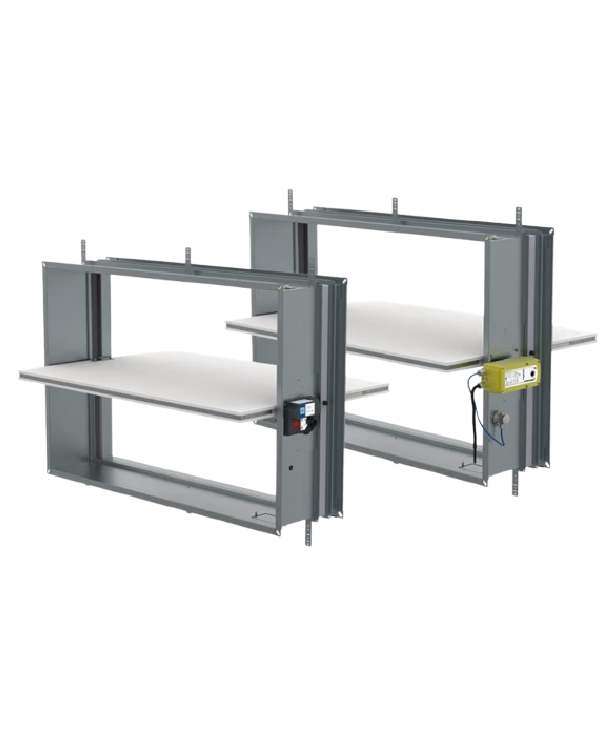
The ATEX FDS_EX Rectangular Fire Damper provides passive fire and smoke protection for HVAC and ventilation systems installed in potentially explosive industrial environments. Companies searching for an Ex Proof Fire Damper in Dubai can use this rectangular damper in oil and gas facilities, petrochemical plants, chemical industries, refineries, hazardous production areas, process buildings, utility rooms, storage facilities, and other locations where both fire compartmentation and explosion-risk control are important.
The FDS_EX is designed for gas and combustible-dust explosive atmospheres and complies with the requirements of the ATEX 2014/34/EU Directive. It belongs to Group II, Category 2G and 2D, provides protection against ignition involving IIB gas atmospheres and IIIB dust atmospheres, and supports Gb and Db Equipment Protection Levels. Fire-resistance installations are available up to EI120S, while the standard casing provides tightness class 3C.
Atex Hub supplies ATEX Fire Dampers across Dubai, Abu Dhabi, Sharjah, Ajman, Ras Al Khaimah, Fujairah, and throughout the UAE, with project support across Saudi Arabia, Qatar, Kuwait, Oman, Bahrain, Europe, Africa, and worldwide.
What Is an ATEX FDS_EX Rectangular Fire Damper?
An ATEX fire damper is a passive fire-protection component installed within ventilation ductwork where the duct passes through fire-rated walls, floors, partitions, or compartment boundaries.
During normal ventilation operation, the damper blade remains open and allows air to pass through the duct. When a fire condition activates the damper, the blade closes and helps maintain the integrity of the fire compartment by restricting the movement of fire, hot gases, and smoke through the HVAC duct.
The FDS_EX version adds construction features suitable for potentially explosive atmospheres. The product is designed for gas and dust explosive environments, while its manual mechanism uses conductive plastic to reduce the possibility of mechanically generated sparking.
Key Features of the Explosion Proof Fire Damper
The Explosion Proof Fire Damper combines certified fire resistance, low leakage, hazardous-area suitability, inspection access, and manual or actuator-based closing arrangements.
- Fire resistance up to EI120S: Approved installation arrangements can provide fire resistance for up to 120 minutes, including integrity, insulation, and smoke-leakage performance.
- Gas and dust hazardous-area suitability: The FDS_EX configuration is designed for potentially explosive environments containing both gas and combustible dust.
- ATEX Group II Category 2G and 2D: The damper is classified for demanding industrial gas and dust applications under the ATEX equipment categorisation.
- IIB gas-group protection: The hazardous-area design addresses ignition risks associated with explosion group IIB gases.
- IIIB dust-group protection: The damper is also designed against ignition hazards involving IIIB combustible-dust atmospheres.
- Spark-resistant manual mechanism: Conductive plastic is used in the manually operated mechanism to help minimise the possibility of mechanically generated sparks.
- Tightness class 3C: The damper provides 3C casing/blade leakage performance as standard, exceeding the basic tightness requirement of the harmonised fire-damper standard.
- Integrated inspection openings: Rectangular units larger than 200 × 200 mm are supplied with two inspection openings for servicing and internal examination.
How Does the Ex Proof Fire Damper Work?
The Ex Proof Fire Damper in Dubai forms part of a building’s passive fire-compartmentation strategy.
Its operating sequence is straightforward:
- During normal HVAC operation, the fire damper remains open.
- Supply or extract air passes normally through the rectangular duct.
- A fire or high-temperature condition activates the damper mechanism.
- The spring or actuator mechanism drives the fire-resistant blade toward the closed position.
- The blade closes across the duct opening.
- Fire, hot gases, and smoke are restricted from passing into the neighbouring fire compartment.
- The surrounding wall or floor construction and the damper installation work together to maintain the required EI or EIS fire-resistance rating.
- After an incident or test, authorised personnel inspect and reset or service the mechanism according to the installation requirements.
The damper itself is therefore only one part of the complete fire-resistant penetration. The tested wall, floor, fixing method, sealing system, damper orientation, and installation arrangement all contribute to the declared fire classification.
Fire Resistance – EI90S and EI120S
The FDS family has assessed performance configurations including:
The fire classification letters describe several important performance characteristics:
- E – Integrity: The damper prevents flames and hot gases from passing through the fire compartment for the declared period.
- I – Insulation: The assembly limits heat transfer through the fire-separating construction.
- S – Smoke leakage: The damper controls smoke leakage through the closed duct penetration.
- 90 / 120: The number identifies the declared fire-resistance duration in minutes for the applicable tested installation.
The FDS handbook lists EI90(ve ho i↔o)S and EI120(ve ho i↔o)S classifications for relevant configurations, including EX subgroups.
ATEX Gas and Dust Protection
The FDS_EX is not simply a standard fire damper with a different label. Its hazardous-area configuration is developed for locations where the ventilation system may operate in a potentially explosive atmosphere.
The product page identifies:
- Equipment Group: II
- Gas Category: 2G
- Dust Category: 2D
- Gas explosion group: IIB
- Dust explosion group: IIIB
- Gas EPL: Gb
- Dust EPL: Db
- Gas temperature class: T6 to T5
- Dust surface-temperature range: approximately T85°C to T100°C, depending on configuration.
This makes the damper suitable for hazardous ventilation projects where both fire compartmentation and control of potential ignition sources form part of the design.
Manual and Actuator Mechanisms
The FDS_EX can use either a manual closing mechanism or actuator-based mechanism, depending on project requirements.
- Manual mechanism: The manually operated version uses specially selected conductive plastic components and is designed to minimise spark generation.
- Actuator mechanism: Motorised configurations can integrate the damper into the building fire-alarm or ventilation-control system.
- Remote activation: Actuated fire dampers can support automatic closure when the fire-safety system sends the appropriate command.
- Position monitoring: Depending on the actuator and system configuration, open/closed status can be monitored by the building management or fire-control system.
- Maintenance testing: Actuated systems allow functional testing as part of scheduled fire-damper inspection programmes.
Tightness Class 3C
The FDS_EX provides tightness class 3C as standard.
Good leakage performance is important because a closed fire damper must not only block direct flame spread; it should also help limit the movement of smoke and hot gases through the duct.
The 3C construction contributes to:
- Improved smoke control.
- Lower leakage through the damper casing.
- Better containment between fire compartments.
- Improved HVAC system tightness during normal operation.
- More consistent performance in fire-rated ventilation installations.
Inspection Openings and Maintenance Access
Inspection access is particularly important because fire dampers remain open for most of their service life and may not operate until a test or genuine emergency occurs.
FDS_EX rectangular dampers with dimensions greater than 200 × 200 mm include two inspection openings.
These openings allow technicians to:
- Inspect the damper blade.
- Check seals.
- Verify the closing mechanism.
- Remove dust and contamination.
- Inspect the internal casing.
- Confirm freedom of blade movement.
- Check fire-resistant components.
- Complete scheduled operational tests.
Fire Damper Construction
The FDS family is designed as a rectangular duct-mounted fire damper for integration into fire-rated ventilation penetrations.
The standard FDS construction uses:
- Galvanised sheet-metal casing
- Fire-resistant damper blade
- Heat-responsive closing mechanism
- Smoke-sealing components
- Fire-resistant / intumescent sealing components
- Manual or actuator operating mechanism
- Duct connection flanges
- Inspection-access points
The handbook confirms that the FDS family is CE-assessed according to EN 15650:2010, with performance evaluated against the applicable fire-resistance requirements.
Applications of the Hazardous Area Fire Damper
The Hazardous Area Fire Damper is suitable for ventilation systems passing through fire compartments in industrial locations where explosive gas or dust atmospheres can occur.
- Oil and gas facilities: ATEX fire dampers support HVAC and ventilation compartmentation in process buildings, utilities, control rooms, compressor areas, and supporting facilities.
- Petrochemical plants: Rectangular dampers help maintain fire compartment boundaries between process, technical, electrical, and occupied spaces.
- Refineries: Fire-rated ventilation penetrations can use ATEX dampers where hydrocarbon vapours may create explosive atmospheres.
- Chemical industries: FDS_EX dampers support process areas handling flammable liquids, gases, solvents, or combustible powders.
- Battery and energy facilities: Hazardous ventilation areas may require both fire compartmentation and ATEX-rated mechanical equipment.
- Paint and coating facilities: Spray, solvent, and mixing areas can require explosion-protected ventilation components.
- Powder-processing industries: The 2D / IIIB dust configuration supports ventilation projects where combustible dust may occur.
- Industrial warehouses: Hazardous material storage buildings may require fire-rated and explosion-protected duct penetrations.
Applications Across Dubai and the UAE
Atex Hub supplies Ex Proof Fire Damper in Dubai solutions for industrial, oil and gas, chemical, HVAC, and hazardous-area projects throughout the UAE.
- Dubai: ATEX fire dampers support industrial plants, hazardous warehouses, chemical facilities, manufacturing, marine industries, utilities, and fire-rated HVAC systems.
- Abu Dhabi: Explosion proof fire dampers support refineries, petrochemical plants, oil and gas facilities, offshore-related infrastructure, processing facilities, and industrial buildings.
- Sharjah: Rectangular ATEX dampers support manufacturing facilities, chemical plants, workshops, paint areas, warehouses, and process industries.
- Ajman: Fire-rated hazardous-area duct systems can use EX dampers across factories, storage facilities, and industrial production buildings.
- Ras Al Khaimah: ATEX fire dampers support cement, mineral, chemical, manufacturing, and heavy-industry ventilation systems.
- Fujairah: Hazardous-area fire dampers support terminals, marine infrastructure, hydrocarbon storage, industrial facilities, and process buildings.
Technical Specifications
| Specification | Product Details |
|---|
| Product Name | ATEX FDS_EX Rectangular Fire Damper |
| Product Type | Rectangular ATEX fire damper |
| Main Function | Passive fire and smoke compartmentation |
| Application | Hazardous-area HVAC / ventilation ductwork |
| Fire Resistance | Up to EI120S |
| Available Assessed Classes | EI90S / EI120S depending on installation |
| Standard Tightness | Class 3C |
| Hazardous Atmosphere | Gas and combustible dust |
| ATEX Group | Group II |
| ATEX Gas Category | 2G |
| ATEX Dust Category | 2D |
| Gas Explosion Group | IIB |
| Dust Explosion Group | IIIB |
| Gas EPL | Gb |
| Dust EPL | Db |
| Gas Temperature Class | T6–T5 |
| Dust Temperature Class | Approx. T85°C–T100°C |
| Mechanism | Manual or actuator |
| Manual Mechanism | Spark-resistant conductive plastic components |
| Inspection Openings | 2 openings for dimensions above 200 × 200 mm |
| Installation Type | Rectangular ventilation duct |
| Fire Damper Standard | EN 15650 |
| Fire Test Standard | EN 1366-2 |
| Fire Classification | EN 13501-3 |
| ATEX Directive | 2014/34/EU |
| Non-Electrical Ex Standard | EN ISO 80079-36:2016 |
The FDS handbook identifies the EX subgroup under the assessed EN 15650 rectangular fire-damper range and lists fire performance up to EI120S.
ATEX Fire Damper vs Standard Fire Damper
Although both products provide fire compartmentation, the ATEX version addresses an additional hazard: potential ignition of an explosive atmosphere.
| Feature | FDS_EX ATEX Fire Damper | Standard Fire Damper |
|---|
| Passive Fire Protection | Yes | Yes |
| Smoke Control | Yes | Yes |
| Fire Rating | Up to EI120S | Model dependent |
| Gas Explosive Atmosphere | Yes | Not necessarily |
| Combustible Dust Atmosphere | Yes | Not necessarily |
| ATEX Category | 2G / 2D | Usually none |
| Gas Group | IIB | Not applicable |
| Dust Group | IIIB | Not applicable |
| Spark-Resistant Mechanism | Yes | Not normally required |
| ATEX Directive | Yes | No |
| EN 15650 | Yes | Yes |
Choose the ATEX FDS_EX where the ventilation system passes through a hazardous area containing flammable gas, vapour, or combustible dust.
Fire Damper vs Smoke Control Damper
Fire dampers and smoke-control dampers perform related but different functions.
- Fire damper: Closes a ventilation duct penetration to preserve the fire resistance of a wall or floor.
- Smoke-control damper: Forms part of an engineered smoke-extraction or smoke-management system and may open or close depending on the fire strategy.
- FDS_EX function: Primarily provides passive fire and smoke compartmentation in hazardous-area ventilation systems.
- System design: The appropriate damper type must match the building’s fire strategy, HVAC arrangement, and smoke-control design.
Selection of Explosion Proof Fire Dampers
Correct selection is essential because the fire classification depends on both the damper and its installation arrangement.
- Determine the required fire rating: Select EI90S, EI120S, or the required classification according to the building’s compartmentation design.
- Confirm wall or floor construction: The selected damper installation must match the tested supporting construction.
- Check hazardous-area classification: Confirm whether the project requires 2G, 2D, or both gas and dust protection.
- Review gas group: Verify that the project’s hazardous gas classification is compatible with IIB.
- Review dust group: Confirm that the combustible-dust classification is compatible with IIIB.
- Choose the mechanism: Select manual or actuator operation according to fire-alarm integration and maintenance requirements.
- Confirm damper dimensions: Match the rectangular duct size and ensure inspection access remains available.
- Review access requirements: Allow sufficient clearance for inspection, testing, reset, actuator service, and blade maintenance.
Installation of the Ex Proof Fire Damper
Fire-damper installation must follow the tested system configuration because the declared EI rating applies to the complete damper and surrounding fire-resistant installation, not the damper alone.
Important installation points include:
- Install at the fire-compartment boundary: Position the damper according to the tested wall, floor, or duct penetration arrangement.
- Use approved installation materials: Fire-resistant sealing and support systems must match the relevant tested configuration.
- Maintain correct orientation: Follow the permitted horizontal or vertical installation arrangement for the selected classification.
- Keep the mechanism accessible: Technicians must be able to reach the actuator or manual closing mechanism.
- Keep inspection openings accessible: Do not hide access covers behind permanent services or building finishes.
- Maintain duct alignment: Avoid mechanical stress or distortion that could prevent free blade movement.
- Connect actuator wiring correctly: Motorised versions must follow both fire-control and hazardous-area electrical requirements.
- Commission the damper: Verify complete opening, automatic closing, blade locking, position indication, and system control before handover.
Inspection and Maintenance
Fire dampers need scheduled testing because they may remain open for long periods before being required to close.
- Inspect the blade: Confirm that the fire-resistant blade is undamaged and free to move.
- Check seals: Inspect smoke and fire-resistant sealing components for damage or deterioration.
- Test the closing mechanism: Verify that the manual or actuator mechanism closes the damper completely.
- Inspect conductive components: Check spark-resistant mechanism components for damage or contamination.
- Check inspection covers: Make sure covers remain correctly fitted after maintenance.
- Remove obstruction: Clean accumulated dust, debris, or foreign material from the damper.
- Check actuator function: Motorised versions should be tested from the fire-control or BMS interface where applicable.
- Document testing: Maintain inspection and functional-test records as part of the building fire-safety programme.
Certifications, Standards and Compliance
The ATEX FDS_EX Rectangular Fire Damper combines fire-resistance compliance with hazardous-area requirements.
- ATEX Directive 2014/34/EU: Covers equipment and protective systems intended for use in potentially explosive atmospheres. The FDS_EX is specifically modified to comply with this directive.
ATEX Directive 2014/34/EU – Official EUR-Lex - EN 15650 – Ventilation for Buildings – Fire Dampers: The FDS family is designed and CE assessed according to EN 15650:2010, the harmonised product standard for fire dampers.
CEN/CENELEC Standards Search - EN 1366-2 – Fire Resistance Tests for Service Installations – Fire Dampers: Defines the fire-test procedure used to evaluate fire dampers for integrity, insulation, and smoke-related performance. The FDS_EX product page specifically identifies this standard.
CEN/CENELEC Standards Search – EN 1366 Series - EN 13501-3 – Fire Classification of Construction Products and Building Elements: Used for fire classification of fire-resistant ducts and dampers based on test results. The FDS handbook lists classifications such as EI90S and EI120S.
CEN/CENELEC Standards Search – EN 13501 Series - EN ISO 80079-36:2016 – Non-Electrical Equipment for Explosive Atmospheres: Covers ignition-hazard assessment and basic requirements for non-electrical Ex equipment. The FDS_EX product page states its EPL classification according to this standard.
ISO 80079-36:2016 – Official ISO - Construction Products Regulation / CE Assessment: The FDS handbook lists CE 1396, declaration reference 1396-CPR-0169, and EN 15650 conformity for the FDS EI90S/EI120S range including EX subgroups.
Why Choose Atex Hub for ATEX Fire Dampers?
Atex Hub supplies ATEX Fire Dampers for fire-rated HVAC systems in oil and gas, petrochemical, refinery, chemical, manufacturing, storage, and other hazardous industrial environments.
- Complete Dubai and UAE coverage: Atex Hub supplies Ex Proof Fire Damper in Dubai, Abu Dhabi, Sharjah, Ajman, Ras Al Khaimah, Fujairah, and industrial locations throughout the UAE.
- Gas and dust applications: Suitable ATEX configurations support projects involving both potentially explosive gases and combustible dust.
- Fire resistance up to EI120S: The rectangular fire-damper platform supports demanding fire-compartmentation requirements.
- Manual and actuator options: Projects can select simple mechanical closing or automatic control-system integration.
- HVAC fire-safety support: Atex Hub can support related hazardous-area dampers, actuators, ventilation components, duct accessories, and fire-safety products.
- Worldwide project supply: Atex Hub supplies ATEX fire dampers across the UAE, Saudi Arabia, Qatar, Kuwait, Oman, Bahrain, Europe, Africa, and worldwide.
Frequently Asked Questions
1. What is an ATEX FDS_EX Rectangular Fire Damper?
It is a rectangular passive fire-protection damper designed for fire-rated HVAC duct penetrations in potentially explosive gas and dust atmospheres.
2. Where can companies use an Ex Proof Fire Damper in Dubai?
It suits oil and gas facilities, petrochemical plants, refineries, chemical industries, paint facilities, hazardous warehouses, manufacturing plants, and process buildings.
3. What fire resistance does the FDS_EX provide?
Applicable installations can provide fire resistance up to EI120S, with assessed FDS configurations including EI90S and EI120S.
4. Is the FDS_EX suitable for gas explosive atmospheres?
Yes. The damper is classified Group II, Category 2G and addresses gas explosion group IIB with Gb Equipment Protection Level.
5. Is it suitable for combustible dust?
Yes. The product also carries Category 2D, supports IIIB dust atmospheres, and provides Db Equipment Protection Level.
6. What is the tightness class?
The FDS_EX provides tightness class 3C as standard.
7. Does the fire damper include inspection openings?
Yes. Rectangular FDS_EX dampers larger than 200 × 200 mm include two inspection openings.
8. Is a motorised version available?
Yes. The damper can use either manual or actuator mechanisms, depending on the selected project configuration.
9. Which fire standards apply to the damper?
The key standards include EN 15650, EN 1366-2, EN 13501-3, ATEX 2014/34/EU, and EN ISO 80079-36.
10. Can Atex Hub supply other ATEX fire and ventilation products?
Yes. Atex Hub supplies ATEX fire dampers, explosion proof dampers, smoke-control products, HVAC equipment, actuators, fans, ducting components, ventilation accessories, and related hazardous-area systems.
Conclusion
The ATEX FDS_EX Rectangular Fire Damper combines passive fire compartmentation with hazardous-area construction for ventilation systems operating in potentially explosive gas and dust environments.
Its fire resistance up to EI120S, tightness class 3C, Group II Category 2G/2D classification, IIB gas and IIIB dust suitability, Gb/Db Equipment Protection Levels, spark-resistant manual mechanism, inspection openings, and compliance with EN 15650, EN 1366-2, ATEX 2014/34/EU, and EN ISO 80079-36 make it suitable for demanding industrial HVAC fire-safety installations.
For companies searching for an Ex Proof Fire Damper in Dubai, the FDS_EX supports oil and gas facilities, refineries, petrochemical plants, chemical industries, manufacturing, hazardous storage, process buildings, and fire-rated industrial ventilation systems throughout Dubai and the wider UAE.
Atex Hub supplies ATEX Fire Dampers throughout the UAE, GCC countries, Europe, Africa, and worldwide.