Sensor Control Module in Sharjah | HVAC Sensor Control Module
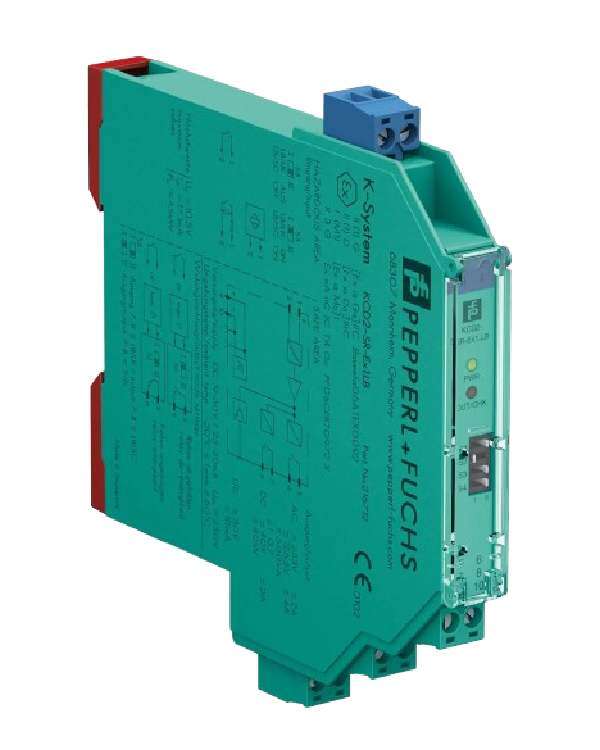
The ATEX Sensor Interface Control Module KCD2-SR-Ex1.LB provides reliable signal transfer between hazardous-area sensors and safe-area control equipment. As a compact Sensor Control Module in Sharjah, it supports oil and gas facilities, refineries, petrochemical plants, chemical processing units, tank farms, utility systems, process skids, industrial HVAC installations, and other hazardous industrial applications.
The module functions as a 1-channel isolated switch amplifier. It accepts signals from NAMUR proximity sensors or mechanical dry contacts located in hazardous areas and transfers the switching status to safe-area control equipment through relay outputs.
The KCD2-SR-Ex1.LB includes line fault detection, a dedicated fault relay option, galvanic isolation, Power Rail compatibility, configurable relay behaviour, and LED indication. Its intrinsically safe input can interface with suitable field devices installed in Zone 0, Zone 1, or Zone 2, while the module itself can be installed in an appropriate Zone 2 arrangement.
Atex Hub supplies ATEX Sensor Control Modules across Sharjah, Dubai, Abu Dhabi, Ajman, Ras Al Khaimah, Fujairah, and throughout the UAE, as well as Saudi Arabia, Qatar, Kuwait, Oman, Bahrain, Europe, Africa, and worldwide.
What Is the KCD2-SR-Ex1.LB Sensor Interface Control Module?
The KCD2-SR-Ex1.LB is an isolated barrier and switch amplifier designed to transfer discrete sensor signals safely from a hazardous area to the plant control system.
The field side accepts signals from NAMUR sensors or mechanical contacts. The module evaluates the incoming current, identifies the switching state, and operates its relay output accordingly. At the same time, it electrically isolates the hazardous-area input from the safe-area control circuitry.
This makes the module suitable for detecting:
- Valve and actuator positions: Interfaces NAMUR proximity sensors or switches used for open, closed, and travel-position feedback.
- End-position monitoring: Detects machine, damper, door, valve, and actuator end stops in hazardous industrial environments.
- Process-switching states: Transfers discrete status from pressure switches, level switches, position sensors, and mechanical contacts.
- Fault conditions: Monitors lead breakage and short circuit in the connected field loop when line fault detection is enabled.
The isolated design also allows the control system to receive a clean relay signal without exposing safe-area equipment to hazardous-area field circuits.
Key Features of the Sensor Control Module
The Sensor Control Module in Sharjah combines intrinsic safety, relay signal transfer, fault diagnostics, and compact DIN-rail construction.
- Single-channel hazardous-area input: Accepts one NAMUR sensor or dry contact and transfers its switching state through an isolated relay interface.
- Dual relay functionality: Output I provides the normal switching signal, while Output II can operate either as a second signal relay or as a dedicated fault relay.
- Line fault detection: Detects lead breakage below approximately 0.1 mA and short circuit above approximately 6.5 mA, helping identify field wiring faults before they affect process control.
- Intrinsically safe field connection: Ex ia input parameters support suitable sensors and contacts located in high-risk hazardous areas, including Zone 0 applications.
- Flexible relay logic: Front switches allow the normal output action to be reversed and let users select whether the second relay follows the signal or reports faults.
- Compact DIN-rail design: A housing width of only 12.5 mm allows high-density installation in instrumentation and control cabinets.
- Power Rail compatibility: Can receive power through terminals or a compatible Power Rail system, which also supports collective fault messaging.
- SIL capability: Suitable for applications up to SIL 2 according to IEC 61508 when applied within the certified safety configuration.
How Does the KCD2-SR-Ex1.LB Work?
The module acts as an interface between a hazardous-area sensor and safe-area automation equipment.
The operating sequence is:
- A NAMUR sensor or mechanical contact connects to the intrinsically safe input.
- The module supplies approximately 10 VDC open-circuit voltage to the field circuit.
- The incoming current changes according to the state of the connected sensor or contact.
- The module compares the current with its switching threshold.
- Relay Output I changes state according to the detected input condition.
- Output II either follows the main switching signal or operates as a fault relay.
- Line fault detection continuously checks for broken or shorted wiring.
- During a detected fault, the relays move to their de-energized state.
- LEDs show power, output status, and field-loop faults.
- The safe-area controller receives the isolated relay signal.
The input switching range is approximately 1.2 to 2.1 mA, with a hysteresis of approximately 0.2 mA.
NAMUR Sensor and Mechanical Contact Interface
The KCD2-SR-Ex1.LB supports two common field-device types.
- NAMUR proximity sensors: These two-wire sensors change their current consumption depending on the detected target position, allowing the module to recognise switching states reliably.
- Mechanical contacts: Dry switches can also connect to the input, making the module useful for limit switches, pressure-switch contacts, float switches, and other simple binary devices.
When mechanical contacts are used with line fault detection, suitable end-of-line resistors can be included so the module can distinguish a normal open circuit from a broken field wire.
Relay Output Operation
The module provides two relay outputs with configurable behaviour.
- Output I: Functions as the primary signal relay and changes state according to the selected input logic.
- Output II: Can either mirror the primary switching state or operate as a dedicated fault indication relay.
- Fail-safe fault response: During a detected lead break or short circuit, the relays return to their de-energized state.
- Fast switching: Relay energizing and de-energizing delay is approximately 20 ms or less, with a switching frequency of up to 10 Hz.
The relay contacts are suitable for PLC inputs, DCS interfaces, alarm circuits, interlocks, indicator circuits, and other safe-area loads within their rated contact limits.
Applications of the Hazardous Area Sensor Control Module
The Hazardous Area Sensor Control Module supports discrete field-signal interfacing across many industrial sectors.
- Oil and gas facilities: Interfaces NAMUR proximity sensors, valve switches, actuator feedback, and equipment-status contacts with safe-area control systems.
- Refineries: Supports end-position monitoring, pump and valve status, process interlocks, and discrete alarm signals.
- Petrochemical plants: Transfers sensor signals from classified areas to PLC and DCS systems while maintaining intrinsic safety.
- Chemical processing plants: Supports switches and sensors around reactors, mixers, transfer systems, storage tanks, and dosing equipment.
- Tank farms: Monitors valve positions, level switches, equipment status, and access or safety contacts.
- Pipeline stations: Interfaces actuator feedback, valve position, pressure-switch contacts, and process status signals.
- Industrial HVAC systems: Supports hazardous-area damper position switches, fan-status contacts, airflow switches, and other binary HVAC signals.
- Process skids: Provides compact isolation between field sensors and package-control systems.
- Pump and compressor stations: Transfers machine status, end-position, trip, and permissive contacts to safe-area controllers.
- Marine and offshore systems: Supports hazardous-area sensor interfacing for deck equipment, process skids, utility systems, and machinery.
Technical Specifications of the KCD2-SR-Ex1.LB
| Specification | Product Details |
|---|
| Product Name | ATEX Sensor Interface Control Module KCD2-SR-Ex1.LB |
| Product Type | 1-channel isolated switch amplifier |
| Signal Type | Digital input |
| Compatible Inputs | NAMUR sensor or mechanical contact |
| Input Terminals | 1+, 2− |
| Input Standard | EN 60947-5-6 |
| Open-Circuit Voltage | Approx. 10 VDC |
| Short-Circuit Current | Approx. 8 mA |
| Switching Point | Approx. 1.2–2.1 mA |
| Switching Hysteresis | Approx. 0.2 mA |
| Lead Break Detection | ≤ 0.1 mA |
| Short-Circuit Detection | ≥ 6.5 mA |
| Output I | Signal relay |
| Output II | Signal relay or fault relay |
| Output I Terminals | 5, 6 |
| Output II Terminals | 7, 8 |
| Supply Connection | Power Rail or terminals 9+, 10− |
| Rated Supply Voltage | 19–30 VDC |
| Rated Current | ≤ 30 mA |
| Power Consumption | ≤ 500 mW |
| Relay Delay | ≤ 20 ms |
| Switching Frequency | ≤ 10 Hz |
| Mechanical Relay Life | Approx. 10⁷ switching cycles |
| Ambient Temperature | −20°C to +60°C |
| Protection Degree | IP20 |
| Housing Width | 12.5 mm |
| Approximate Dimensions | 12.5 × 114 × 119 mm |
| Approximate Mass | 100 g |
| Mounting | 35 mm DIN rail |
| Functional Safety | Up to SIL 2 |
| ATEX Certificate | BASEEFA 06 ATEX 0092 X |
| IECEx Certificate | IECEx BAS 06.0025 X |
The current datasheet confirms a 19–30 VDC supply, ≤30 mA rated current, ≤500 mW power consumption, IP20 protection, and a −20°C to +60°C ambient operating range.
Intrinsic Safety and Hazardous Area Protection
The KCD2-SR-Ex1.LB provides an intrinsically safe input for connected field devices.
A current ATEX marking for the product family includes:
II 3(1)G Ex ec nC [ia Ga] IIC T4 Gc
II (1)D [Ex ia Da] IIIC
I (M1) [Ex ia Ma] I
These approvals allow suitable intrinsically safe field circuits to connect to equipment in gas, dust, and mining hazardous environments, while the interface itself is installed according to its certified protection concept.
Representative intrinsically safe input parameters include:
| Intrinsic Safety Parameter | Value |
| Output Voltage Uo | 10.5 V |
| Output Current Io | 13 mA |
| Output Power Po | 34 mW |
These parameters must be matched with the connected sensor, cable capacitance, cable inductance, and applicable hazardous-area installation requirements.
Galvanic Isolation and Electrical Safety
The module electrically separates the field input, relay outputs, and supply system.
- Input-to-output isolation: Provides safe electrical isolation between the intrinsically safe field circuit and the safe-area relay side.
- Input-to-supply isolation: Separates the hazardous-area input from the power circuit.
- Output-to-output isolation: Reinforced insulation between the two relay circuits improves separation between connected safe-area loads.
This isolation reduces the possibility of unwanted ground paths and protects control equipment from hazardous-area field-circuit energy.
Line Fault Detection
One of the main advantages of the KCD2-SR-Ex1.LB is its integrated Line Fault Detection (LFD).
The module can identify:
- Broken field wiring: Detected when the input current falls to approximately 0.1 mA or below.
- Shorted field wiring: Detected when input current rises to approximately 6.5 mA or above.
- Sensor wiring faults: The module communicates the problem through relay behaviour and front-panel fault indication.
- Collective Power Rail faults: Compatible Power Rail installations can combine device faults and forward them through a common error message system.
LFD can be enabled or disabled using the front configuration switches.
Front Switch Configuration
The front switches provide straightforward field configuration.
- Switch S1 – Output operating mode: Selects whether Output I energizes with high or low input current.
- Switch S2 – Output II function: Selects whether the second relay follows the main signal or functions as a fault relay.
- Switch S3 – Line fault detection: Enables or disables lead-break and short-circuit monitoring.
- Switch S4: Reserved with no operational function.
This configuration allows the same module to adapt to different plant fail-safe and alarm philosophies without software programming.
Power Rail Integration
The KCD2-SR-Ex1.LB can receive its 24 VDC supply through a compatible Power Rail system.
- Simplified power distribution: Multiple interface modules can receive power through the common DIN-rail system instead of separate supply wiring for every unit.
- Collective fault messaging: Compatible Power Rail equipment can combine fault signals from multiple modules and transfer a common alarm to the control system.
- High-density cabinet design: The 12.5 mm housing and shared power distribution help reduce control-panel wiring and cabinet space.
The device can also receive its supply directly through terminals 9+ and 10− when Power Rail is not used.
Selection, Installation and Maintenance
Correct installation helps preserve intrinsic safety, relay reliability, and diagnostic performance.
- Select compatible field devices: Use NAMUR sensors or mechanical contacts whose intrinsic-safety parameters match the certified input circuit.
- Verify the hazardous-area loop: Check Uo, Io, Po, cable capacitance, cable inductance, and sensor entity values before commissioning.
- Use the correct supply: Provide a stable 19–30 VDC supply through the terminals or compatible Power Rail system.
- Configure relay logic correctly: Set S1 and S2 according to the required normal, alarm, and fail-safe behaviour.
- Enable LFD where required: Use line fault detection for applications where broken or shorted field wiring must generate an alarm.
- Install on DIN rail: Mount the module on a 35 mm rail inside a suitable enclosure and protect it from mechanical damage.
- Maintain terminal separation: Follow hazardous-area wiring practices for intrinsically safe and non-intrinsically safe circuits.
- Test fault behaviour: During commissioning, verify normal switching, lead-break detection, short-circuit detection, relay de-energization, and LED indication.
- Inspect periodically: Check terminals, Power Rail connections, cabinet condition, sensor wiring, and relay operation during planned maintenance.
Certifications, Standards and Compliance
The KCD2-SR-Ex1.LB supports hazardous-area sensor interfacing and functional safety under recognised industrial standards.
- ATEX Directive 2014/34/EU: Covers equipment and protective systems intended for use in potentially explosive atmospheres.
- IECEx Certification System: Provides international certification for equipment used in explosive atmospheres.
- IEC 60079-11 – Intrinsic Safety “i”: Covers intrinsically safe electrical equipment and circuits.
- IEC 61508 – Functional Safety: Provides the functional-safety framework supporting the module’s SIL 2 capability.
Why Choose Atex Hub for ATEX Sensor Control Modules?
Atex Hub supplies ATEX Sensor Control Modules and hazardous-area interface components for sensor isolation, relay switching, process automation, fault monitoring, and safe-area signal transfer.
- Supply across Sharjah and the UAE: Atex Hub supplies Sensor Control Modules across Sharjah, Dubai, Abu Dhabi, Ajman, Ras Al Khaimah, Fujairah, and other major UAE industrial locations.
- NAMUR sensor interface solutions: Provides isolated barriers and switch amplifiers for NAMUR proximity sensors, mechanical contacts, valve switches, and end-position detection.
- Intrinsic-safety integration: Supports hazardous-area applications that require intrinsically safe field loops between Zone 0/1 sensors and safe-area control equipment.
- Relay and fault monitoring solutions: Supplies interfaces with signal relays, fault relays, line fault detection, Power Rail connectivity, and local diagnostics.
- Process-control integration: Supports connection to PLC, DCS, ESD, alarm, interlock, and industrial monitoring systems.
- Complete installation accessories: Supplies Power Rail systems, feed modules, DIN rails, enclosures, terminals, cables, glands, barriers, and related hazardous-area components.
- Worldwide industrial supply: Supports projects across the UAE, Saudi Arabia, Qatar, Kuwait, Oman, Bahrain, Europe, Africa, and worldwide.
Frequently Asked Questions
1. What is the KCD2-SR-Ex1.LB Sensor Control Module?
The KCD2-SR-Ex1.LB is a one-channel isolated switch amplifier that transfers NAMUR sensor or mechanical contact signals from hazardous areas to safe-area control systems.
2. Is it suitable as a Sensor Control Module in Sharjah?
Yes. The Sensor Control Module in Sharjah supports hazardous-area sensor interfacing for refineries, petrochemical plants, oil and gas facilities, process skids, and industrial HVAC systems.
3. Which sensors can connect to the module?
It supports NAMUR proximity sensors and mechanical dry contacts.
4. How many relay outputs does it provide?
The module provides two relay outputs, with the second output configurable as either a signal relay or fault relay.
5. Does it detect broken sensor wiring?
Yes. Integrated line fault detection identifies both lead breakage and short circuits.
6. What supply voltage does it require?
The module operates from 19–30 VDC through terminals or a compatible Power Rail system.
7. Can it connect to a Zone 0 sensor?
Yes. Its intrinsically safe field input supports suitable certified devices installed in Zone 0 when the complete loop meets the approved entity parameters.
8. Does the module support SIL applications?
Yes. It supports applications up to SIL 2 according to IEC 61508 within the applicable safety configuration.
9. How is the module installed?
It mounts on a standard 35 mm DIN rail inside a suitable control or interface cabinet.
10. Can Atex Hub supply the complete interface system?
Yes. Atex Hub supplies the switch amplifier, Power Rail, power feed modules, enclosures, terminals, cables, glands, and associated intrinsic-safety components.
Conclusion
The ATEX Sensor Interface Control Module KCD2-SR-Ex1.LB provides a compact and dependable way to transfer discrete sensor signals from hazardous areas into safe-area automation systems.
Its single intrinsically safe input accepts NAMUR sensors or mechanical contacts, while two relay outputs provide process switching and optional fault reporting. Integrated Line Fault Detection identifies broken or shorted field wiring and moves the relays to a defined de-energized state during faults.
A 19–30 VDC supply, Power Rail compatibility, 12.5 mm housing width, DIN-rail mounting, galvanic isolation, and configurable relay logic support high-density industrial control panels. The module also supports applications up to SIL 2 and carries ATEX and IECEx approvals for hazardous-area interfacing.
For organisations seeking a Sensor Control Module in Sharjah, the KCD2-SR-Ex1.LB supports valve position monitoring, machine end stops, level switching, equipment status, process interlocks, and other hazardous-area sensor applications.
Atex Hub supplies ATEX Sensor Control Modules across Sharjah, the UAE, GCC countries, Europe, Africa, and worldwide.