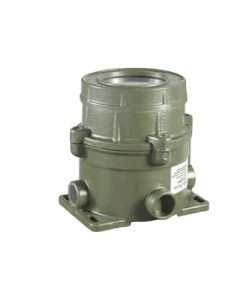
Intrinsically Safe Control Station in Kuwait | IS Control Stations
The ATEX Control Station for Zone 1/21 gives operators a safe local control point in hazardous areas. It helps them control motors, pumps, alarms, lighting circuits, reset functions, emergency stop functions, instruments, and process equipment in explosive gas and dust locations.
For companies searching for Intrinsically Safe Control Station in Kuwait, this product suits ATEX control switch, Ex proof control switch, explosion proof enclosure, flame proof enclosure, intrinsically safe enclosure, hazardous area enclosure, and IS control switch requirements. It works well in oil & gas plants, refineries, petrochemical facilities, marine sites, chemical plants, power stations, utilities, manufacturing plants, and automation projects.
Atex Hub supplies ATEX control stations globally across Kuwait, UAE, Saudi Arabia, Qatar, Oman, Bahrain, Europe, Africa, and worldwide, supporting certified hazardous area control station requirements.
What Is an ATEX Control Station for Zone 1/21?
An ATEX control station for Zone 1/21 is a certified local control and indicating unit for hazardous areas. Operators use it to start, stop, reset, signal, isolate, or control field equipment safely. It can hold push buttons, selector switches, pilot lights, control switches, indicators, labels, cable glands, terminals, and accessories.
This control station suits Zone 1 gas hazardous areas and Zone 21 dust hazardous areas. It can also support related Zone 2 and Zone 22 project requirements when the final configuration and site classification match. The product data shows explosion protection markings for Ex db eb IIC T6 Gb, Ex db eb ia IIC T6 Gb, and Ex tb IIIC T80°C Db. These markings help support both hazardous gas and combustible dust applications.
The enclosure uses thermoplast material and provides protection up to IP66/IP67. It also supports 690 V AC rated insulation voltage, 16 A nominal current, 2.5 mm² terminals, and 4 x 2.5 mm² PE conductor terminals.
Key Features of Intrinsically Safe Control Stations
This intrinsically safe control station helps site teams control equipment safely in hazardous areas. It gives engineers flexibility to select the right operators, cable glands, terminals, labels, and accessories based on the project.
- Ideal for Intrinsically Safe Control Station in Kuwait
- Suitable for ATEX Control Switch and Ex Proof Control Switch applications
- Works as a Hazardous Area Enclosure for local control devices
- Supports Explosion Proof Enclosure and Flame Proof Enclosure project searches
- Supports IS Control Switch applications when the circuit design uses approved Ex i components
- Suitable for Zone 1/21 hazardous area projects
- Supports gas and dust hazardous area installations
- Offers 3 standard enclosure options
- Allows customer-specific local control and indication layouts
- Supports combinations of up to three control station enclosures
- Provides protection up to IP66/IP67
- Uses thermoplast enclosure material
- Supports M20 x 1.5 and M25 x 1.5 cable glands
- Allows individual information labels for easier operation
- Supports special oil-resistant attachments for offshore applications
The control station system offers three standard enclosures, flexible customer-specific solutions, and combinations of up to three enclosures. It also supports plastic or metal cable glands for electrical connection.
Applications of ATEX Control Stations
The ATEX Zone 1/21 control station helps operators control equipment safely in hazardous industrial sites. It suits areas where standard switches and control boxes cannot meet explosion protection requirements.
- Oil & Gas Facilities – Operators use the control station for pumps, skids, process equipment, alarms, and emergency stop points.
- Refineries – Site teams install it near process units, tank farms, loading areas, utility plants, and pump stations.
- Petrochemical Plants – It supports start, stop, reset, signal, and alarm functions where gas, vapour, and chemicals may exist.
- Chemical Processing Units – The enclosure suits areas with chemical vapour, moisture, dust, and outdoor exposure.
- Marine and Offshore Areas – It works well in salty, humid, offshore, and outdoor industrial environments.
- Power Plants – Operators use it for local control of auxiliary systems, lighting circuits, alarms, and field devices.
- Manufacturing and Logistics Sites – It supports safe control where combustible gases, vapours, mists, or dusts can appear during production or transport.
- Dust Hazardous Areas – It supports Zone 21 applications where combustible dust may create an ignition risk.
- Hydrogen and LNG Facilities – It supports local control needs in modern energy facilities where certified explosion protection matters.
- Kuwait Industrial Projects – It suits Kuwait City, Mina Al Ahmadi, Shuaiba, Al Zour, Mina Abdullah, Ahmadi, ports, utilities, factories, and infrastructure work.
The product page highlights use across oil and gas, chemical, energy, hydrogen, manufacturing, logistics, food, and beverage applications where explosion protection is required.
Technical Specifications
| Specification | Details |
|---|
| Product Name | ATEX Control Stations for Zone 1/21 |
| Product Type | Hazardous Area Local Control and Indicating Unit |
| Enclosure Material | Thermoplast |
| Protection Class | Up to IP66/IP67 |
| Impact Resistance | 7 Nm impact energy |
| Rated Insulation Voltage | Max. AC 690 V |
| Nominal Current | Max. 16 A |
| Terminals | 2.5 mm² |
| PE Terminals | 4 x 2.5 mm² |
| Cable Gland Options | M20 x 1.5 and M25 x 1.5 |
| Zones | Zone 1/21 |
| Supplier | Atex Hub |
Hazardous Area Selection Guide
The correct intrinsically safe control station depends on the site zone, control function, operator type, cable entry layout, protection method, IP rating, and certification requirement. Always match the final control station configuration with the project’s hazardous area classification.
| Selection Point | What to Check |
|---|
| Gas Zone | Confirm Zone 1 or Zone 2 requirement |
| Dust Zone | Confirm Zone 21 or Zone 22 requirement |
| Control Function | Choose push button, selector switch, pilot light, indicator, control switch, or emergency stop |
| Protection Type | Confirm Ex e, Ex i, Ex d, Ex tb, or mixed protection |
| Material | Choose thermoplast enclosure design where the project allows it |
| Operators | Confirm the required control and indicating devices |
| Cable Entries | Confirm M20 or M25 gland size and cable diameter |
| Labels | Add clear information labels for safe field operation |
| IP Rating | Maintain IP66/IP67 after installation |
| Offshore Need | Select oil-resistant attachments where offshore exposure requires them |
Ex i, Ex e and Flame Proof Protection Guide
| Protection Type | Meaning | Common Use |
|---|
| Ex i / Intrinsic Safety | Limits electrical energy to prevent ignition | Low-energy signals, indicators, instruments, and control circuits |
| Ex e / Increased Safety | Reduces ignition risk through safe terminals, spacing, insulation, and temperature control | Control stations and terminal wiring |
| Ex d / Flameproof | Contains internal ignition inside a certified enclosure | Flameproof control equipment |
| Ex tb | Protects equipment in combustible dust areas | Zone 21 and Zone 22 |
| IP66/IP67 | Protects against dust and water ingress | Outdoor, industrial, and washdown areas |
IS Control Switch Use
An IS control switch uses an intrinsically safe circuit. The circuit limits electrical energy so sparks or heat cannot ignite the hazardous atmosphere under approved conditions.
For Intrinsically Safe Control Station in Kuwait projects involving IS circuits:
- Use approved Ex ia or Ex ib circuits where the project requires intrinsic safety.
- Separate intrinsically safe and non-intrinsically safe circuits.
- Use approved barriers, isolators, terminals, and field devices.
- Mark IS circuits clearly during installation.
- Confirm cable glands and stopping plugs match the hazardous area.
- Check the final certificate and marking plate before commissioning.
- Follow the project hazardous area classification and inspection checklist.
This supports safer control for alarms, signals, reset functions, instrumentation, low-energy switches, and field controls.
Control Station vs Control Switch
| Type | Best Use |
|---|
| Control Station | Best for multiple operators such as push buttons, indicators, selector switches, and emergency stops |
| Control Switch | Best for one switching function such as ON/OFF, start/stop, or isolation |
| IS Control Station | Best for low-energy instrument and signal control circuits |
| Flameproof Control Station | Best where the project requires Ex d flameproof protection |
| Hazardous Area Enclosure | Best for housing certified control, terminal, and wiring components |
Certifications, Standards & Compliance
Certifications help buyers choose the correct control station for hazardous area projects. The final control station must match the site zone, protection type, operator design, cable glands, cable entries, IP rating, ambient temperature, and inspection requirement.
The product data lists ATEX, IECEx, UKEX, CSA, CCC, KCS, ECAS, and other certification documents. It also lists ATEX markings Ex II 2G Ex db eb IIC T6 Gb, Ex II 2G Ex db eb ia IIC T6 Gb, and Ex II 2D Ex tb IIIC T80°C Db.
- ATEX Certification – Supports European hazardous area equipment compliance.
- IECEx Certification – Supports international certification for equipment used in explosive atmospheres.
- Ex e Increased Safety – Supports safe control station wiring and terminal arrangements.
- Ex ia Intrinsic Safety – Supports intrinsically safe control and signal circuits when approved components are used.
- Ex d Flameproof Protection – Supports flameproof protection where the final assembly uses certified flameproof components.
- Ex tb Dust Protection – Supports combustible dust hazardous area installations.
- IP66/IP67 Protection – Helps protect the control station from dust, water jets, and short-term water exposure depending on configuration.
- Project Compliance Check – Always confirm Ex marking, certificate, operator type, cable glands, ambient temperature, and site classification.
Installation & Usage Notes
Correct installation keeps the ATEX Zone 1/21 control station safe and reliable. The installer must check the certificate, Ex marking, cable glands, cable entries, operators, labels, sealing, and unused entries before energising the circuit.
- Select the correct intrinsically safe control station for the site zone.
- Confirm Zone 1/21 requirement before installation.
- Use certified Ex cable glands, adaptors, stopping plugs, reducers, and locknuts.
- Confirm operator quantity and control function before ordering.
- Keep wiring neat and avoid overcrowding.
- Separate IS and non-IS circuits where required.
- Keep sealing surfaces clean and undamaged.
- Maintain the required IP66/IP67 rating.
- Use clear information labels for field operation.
- Inspect operators, cable glands, labels, seals, screws, and enclosure condition during maintenance.
Why Choose This Hazardous Area Control Station
The ATEX Control Station for Zone 1/21 gives industries a flexible local control and indication solution for hazardous areas. It supports push buttons, selector switches, indicators, labels, cable glands, terminals, and customised operator layouts.
For Kuwait projects, this control station suits oil & gas, petrochemical, refinery, chemical, marine, power, manufacturing, logistics, utilities, and infrastructure applications. Its Zone 1/21 suitability, IP66/IP67 protection, 690 V AC rated insulation voltage, 16 A nominal current, and custom control layout options make it useful for demanding hazardous area installations.
- Ideal for Intrinsically Safe Control Station in Kuwait
- Suitable for ATEX Control Switch requirements
- Works as a Hazardous Area Enclosure control solution
- Supports Explosion Proof Enclosure and Flame Proof Enclosure project searches
- Supports Ex Proof Control Switch applications
- Supports IS Control Switch requirements when the circuit design uses approved Ex i components
- Offers flexible standard and custom control layouts
- Supports harsh industrial and energy projects
- Supplied globally by Atex Hub
Frequently Asked Questions
1. What is an ATEX Control Station for Zone 1/21 used for?
It controls pumps, motors, alarms, lighting circuits, emergency stop functions, and field devices in hazardous areas.
2. Is this suitable for Intrinsically Safe Control Station in Kuwait projects?
Yes, it suits Kuwait hazardous area projects when the final Ex marking, operator layout, cable entries, and circuit design match the site requirement.
3. Which hazardous zones can it support?
It supports Zone 1/21 applications and can suit related gas and dust hazardous area projects when the final configuration matches the site classification.
4. What material does the enclosure use?
The enclosure uses thermoplast material.
5. What IP rating does it provide?
It provides protection up to IP66/IP67.
6. What is the maximum rated insulation voltage?
The listed rated insulation voltage is max. AC 690 V.
7. What is the maximum nominal current?
The listed nominal current is max. 16 A.
8. Can it support IS control switch applications?
Yes, it can support IS control circuits when approved Ex i components and wiring rules are used.
9. What cable gland options are available?
The product data lists plastic stuffing box glands in M20 x 1.5 and M25 x 1.5, with metal cable gland options also available.
10. Who supplies ATEX control stations globally?
Atex Hub supplies ATEX control stations across Kuwait, UAE, Saudi Arabia, Qatar, Oman, Bahrain, Europe, Africa, and worldwide.
Conclusion
The ATEX Control Station for Zone 1/21 gives operators a safe and flexible local control point in hazardous gas and dust environments. It supports push buttons, selector switches, indicators, emergency stop functions, labels, terminals, cable glands, and customised control layouts.
For buyers searching for Intrinsically Safe Control Station in Kuwait, this product offers strong value for oil & gas, petrochemical, refinery, marine, chemical, power, manufacturing, logistics, utility, and automation projects. Its Zone 1/21 suitability, IP66/IP67 protection, thermoplast enclosure, 690 V AC rated insulation voltage, 16 A nominal current, and custom configuration options make it suitable for demanding industrial installations.
Atex Hub supplies ATEX Zone 1/21 control stations globally across Kuwait, UAE, Saudi Arabia, Qatar, Oman, Bahrain, Europe, Africa, and worldwide, helping industries source safe and compliant hazardous area control station solutions.