Explosion Proof HT Centrifugal Fan in UAE | HT Fans Supplier UAE
The ATEX High-Temperature Centrifugal Fan KBE Series is designed for demanding industrial ventilation and process-air applications where hot gases, high airflow, elevated pressure, and hazardous-area protection must be handled together. Companies searching for an Explosion Proof HT Centrifugal Fan in UAE can use this type of centrifugal fan in oil and gas facilities, refineries, petrochemical plants, power stations, steel plants, incineration systems, process furnaces, boiler installations, hot-air circulation systems, cooling systems, and other hazardous industrial environments.
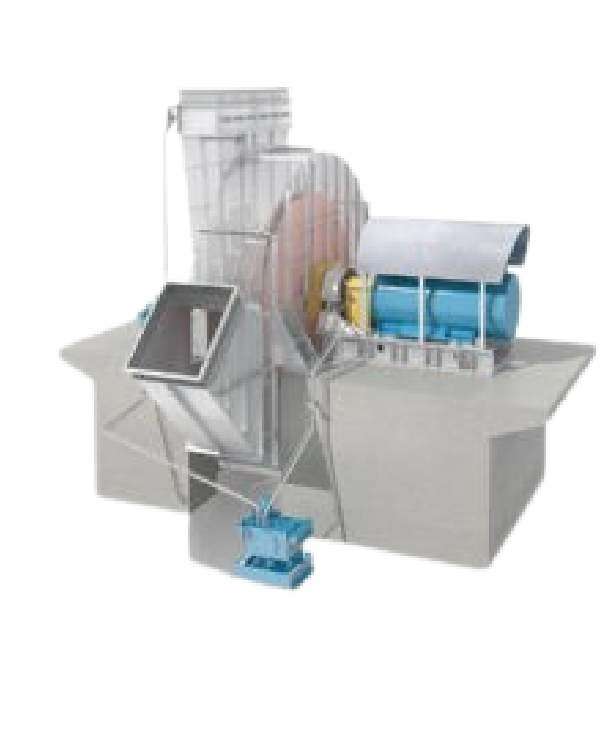
The KBE Series is a single-inlet, overhung-impeller centrifugal fan driven through a coupling and mounted on a concrete foundation. Within the K Series, the KBE supports airflow from approximately 48,000 to 1,200,000 m³/h, total pressure from around 2,500 to 35,500 Pa, rotational speeds from 1,000 to 1,800 rpm, motor powers from approximately 132 to 5,000 kW, and process temperatures from -50°C to +500°C. ATEX, high-temperature, corrosion-resistant, wear-resistant, gas-tight, dust-tight, pressure-shock-resistant, and hygienic design variants are available according to project requirements.
Atex Hub supplies ATEX High-Temperature Fans across Dubai, Abu Dhabi, Sharjah, Ajman, Ras Al Khaimah, Fujairah, and throughout the UAE, with project support across Saudi Arabia, Qatar, Kuwait, Oman, Bahrain, Europe, Africa, and worldwide.
What Is an ATEX High-Temperature Centrifugal Fan?
An ATEX High-Temperature Centrifugal Fan is an industrial radial fan engineered to move hot air, process gases, combustion gases, exhaust gases, or cooling air while operating in locations where explosive gases, vapours, or combustible dust may also be present.
The KBE construction uses a coupling drive, concrete foundation, overhung impeller, and single-inlet arrangement. This layout separates the motor from the hot process-air stream and provides a robust mechanical platform for high-power industrial operation.
High-temperature versions also use specialised cooling, sealing, insulation, and thermal-separation measures to protect bearings and mechanical components from process temperatures that can reach approximately 500°C.
Key Features of the Explosion Proof HT Centrifugal Fan
The Explosion Proof HT Centrifugal Fan in UAE combines high-volume air movement, high static pressure, thermal protection, and explosion-protected construction for heavy industrial processes.
- High-temperature operation: Special high-temperature construction supports hot process media up to approximately 500°C.
- Very high airflow capacity: The KBE performance envelope reaches approximately 48,000 to 1,200,000 m³/h, supporting large process and ventilation systems.
- High pressure capability: Total pressure ranges from approximately 2,500 to 35,500 Pa, making the fan suitable for demanding duct, boiler, filtration, and process systems.
- Powerful drive systems: Motor ratings extend from roughly 132 kW to 5,000 kW, depending on the selected size and duty point.
- Coupling-driven design: The KBE uses a coupling drive, which helps keep the motor separated from the hot gas stream.
- Single-inlet construction: The fan uses a single-width, single-inlet configuration with an overhung impeller.
- ATEX design availability: Explosion-protected versions are available for applications involving combustible dust or flammable gases.
- Multiple protection options: KBE variants can incorporate wear protection, corrosion protection, pressure-shock resistance, gas-tightness, liquid-tightness, dust-tightness, and hygienic construction.
How Does the High-Temperature Centrifugal Fan Work?
The fan converts motor power into airflow and pressure through a rotating centrifugal impeller.
The operating sequence is straightforward:
- Hot process air or gas enters through the single inlet.
- The rotating impeller accelerates the gas radially outward.
- Centrifugal force increases the gas velocity.
- The scroll-shaped housing converts part of this velocity into static pressure.
- Pressurised gas exits through the discharge opening.
- A coupling transfers power from the motor to the fan shaft.
- Bearings support the shaft and rotating impeller.
- High-temperature cooling and insulation measures reduce heat transfer toward sensitive components.
- ATEX-specific construction reduces potential ignition risks in hazardous atmospheres.
- The fan delivers the required airflow into the connected duct or process system.
High-Temperature Design up to 500°C
Handling gas at several hundred degrees Celsius requires more than simply using thicker steel.
The high-temperature fan design can incorporate:
- Thermal separation: The pedestal and fan housing can be thermally separated to reduce heat transfer into bearings and drive components.
- Heat flinger: A heat-deflection arrangement helps prevent excessive shaft heat from travelling toward the bearing system.
- Additional cooling fan: A secondary cooling fan can support the heat flinger and stabilise bearing temperature during very hot operation.
- Insulation components: Thermal insulation helps contain process heat and protect surrounding equipment.
- Special sealing: High-temperature sealing arrangements help maintain safe operation around the shaft passage.
- Temperature-resistant materials: Construction materials can be selected according to process temperature and gas composition.
These measures allow the fan to handle process temperatures up to approximately 500°C while maintaining stable mechanical operation.
Explosion Protection and ATEX Construction
Where combustible gases or dust may be present, the fan can be supplied in an ATEX explosion-protected configuration.
Explosion-protected fan construction can include:
- Constructional safety adapted to the ATEX category: Mechanical clearances and component selection are designed around the required hazardous-area classification.
- Special shaft seals: Shaft passages can use dedicated sealing arrangements to limit leakage and help control ignition risks.
- Continuous weld seams: Fully welded housings improve integrity in hazardous process applications.
- High-quality impeller balancing: Precise balancing reduces vibration and the risk of unwanted mechanical contact.
- Electrical grounding provisions: Grounding helps dissipate electrostatic charge.
- Spark-risk reduction: Materials and clearances can be selected to minimise the possibility of mechanically generated sparks.
- ATEX quality documentation: Explosion-protected fan versions are tested and recorded as part of the applicable quality-assurance process.
The reference manufacturer states that its ATEX fan design complies with EN 14986:2017 – Design of fans working in potentially explosive atmospheres.
Airflow, Pressure and Motor Performance
The KBE Series covers a broad industrial performance range.
| Parameter | KBE Series Range |
|---|
| Total Pressure | Approx. 2,500–35,500 Pa |
| Airflow | Approx. 48,000–1,200,000 m³/h |
| Rotational Speed | Approx. 1,000–1,800 rpm |
| Motor Power | Approx. 132–5,000 kW |
| Process Temperature | Approx. -50°C to +500°C |
These values make the KBE suitable for large industrial ventilation, boiler, cooling, exhaust, and hot-process-air applications.
Coupling Drive and Overhung Impeller Design
The KBE uses a coupling-driven, single-inlet, overhung-impeller configuration installed on a concrete foundation.
This arrangement provides several advantages:
- Motor separation from hot gas: The coupling arrangement keeps the motor away from the hottest section of the fan.
- Strong bearing support: The shaft and bearing system support large impellers and heavy industrial loads.
- Stable concrete installation: A substantial foundation helps control vibration on very large machines.
- Maintenance access: The coupling arrangement allows inspection of motor, shaft, and bearings as separate components.
- High-power suitability: The design supports motors reaching several megawatts.
- Industrial durability: It suits continuous operation in power, steel, refinery, and process-plant applications.
Airflow Control and Energy Efficiency
Large centrifugal fans rarely operate at one fixed duty point throughout their entire service life.
Flow can typically be controlled using:
- Inlet dampers.
- Guide vanes.
- Variable-speed drives.
- Process control signals.
- DCS or PLC automation.
Variable-speed control can reduce unnecessary energy use when the process does not require full fan output.
The K Series modular design also supports customised drive systems and accessories to match site-specific operating requirements.
Pressure-Shock-Resistant Construction
Industrial fans can sometimes be exposed to pressure surges resulting from process disturbances or combustion events.
Pressure-shock-resistant fan designs can be engineered for approximately 0.2 to 10 bar absolute, depending on the project. This construction can include:
- Continuously welded housings.
- Increased housing wall thickness.
- Reinforced flanges.
- Stronger bolting.
- Radial stiffeners.
- Dye-penetration inspection of critical welds.
This option can be important in chemical, dust-handling, combustion, and process applications where abnormal pressure events form part of the design basis.
Gas-Tight, Liquid-Tight and Dust-Tight Options
Hot industrial gases may also contain toxic, corrosive, dusty, or otherwise problematic process media.
KBE design variants therefore include gas-tight, liquid-tight, and dust-tight construction.
Depending on application requirements, sealing can include:
- Gas-tight housing welds.
- Multi-chamber labyrinth seals.
- Barrier-gas arrangements.
- Grease seals.
- Sealed shaft passages.
- Tight flange connections.
These options help prevent hazardous process media from escaping into the surrounding work area.
Corrosion and Wear Protection
High-temperature process gases may carry corrosive compounds or abrasive particles.
The fan can therefore be configured with:
- Corrosion-resistant materials or coatings for chemically aggressive gas streams.
- Wear-resistant liners or surfaces for dusty and abrasive process gases.
- Stainless-steel components where process compatibility requires them.
- Custom material selection according to temperature, chemistry, and particulate loading.
- Replaceable wear elements in heavily abrasive installations.
These design choices can increase service life and reduce maintenance frequency.
Applications of the Hazardous Area High-Temperature Fan
The Hazardous Area High-Temperature Fan supports demanding ventilation and process-air duties across heavy industry.
- Power plants: KBE fans can support FD, ID, PA, and SA duties in power-station boilers, together with cooling-air applications.
- Oil and gas facilities: High-temperature centrifugal fans can operate as exhaust fans and hot-air fans in applicable process systems.
- Refineries: Fans support combustion, exhaust, hot-air handling, process heating, cooling, and flue-gas applications.
- Petrochemical plants: ATEX designs support process-air and ventilation duties where flammable gases may be present.
- Steel plants: Large centrifugal fans support furnace, boiler, exhaust, cooling, and process-air systems.
- Incineration plants: High-temperature fans can extract combustion gases and maintain required process draft.
- Industrial boilers: FD, ID, PA, and SA fan duties maintain combustion-air and flue-gas movement.
- Process furnaces and kilns: Fans support hot-air circulation, exhaust extraction, cooling, and combustion systems.
Applications Across the UAE
Atex Hub supplies Explosion Proof HT Centrifugal Fan in UAE solutions across major industrial areas.
- Abu Dhabi: High-temperature ATEX centrifugal fans support oil and gas processing, refineries, petrochemical facilities, power generation, offshore projects, and industrial utilities.
- Dubai: Fans support manufacturing plants, industrial boilers, waste-processing facilities, chemical operations, marine industries, and process ventilation.
- Sharjah: Explosion-protected fans support factories, steel processing, chemical plants, foundries, furnaces, and industrial exhaust systems.
- Ras Al Khaimah: High-temperature fans support cement, ceramics, minerals processing, heavy manufacturing, and industrial heating systems.
- Fujairah: Centrifugal fans support terminals, power facilities, marine projects, bulk handling, fuel operations, and industrial exhaust applications.
- Ajman: Fans support manufacturing, industrial boilers, process heating, workshops, and ventilation systems.
Technical Specifications
| Specification | Product Details |
|---|
| Product Name | ATEX High-Temperature Centrifugal Fan KBE Series |
| Fan Type | Industrial centrifugal / radial fan |
| Fan Series | KBE |
| Inlet Design | Single inlet |
| Impeller Arrangement | Overhung |
| Drive Arrangement | Coupling drive |
| Foundation | Concrete foundation |
| Airflow Range | Approx. 48,000–1,200,000 m³/h |
| Total Pressure Range | Approx. 2,500–35,500 Pa |
| Rotational Speed | Approx. 1,000–1,800 rpm |
| Motor Power Range | Approx. 132–5,000 kW |
| Temperature Range | Approx. -50°C to +500°C |
| High-Temperature Design | Yes |
| ATEX Design | Available |
| Pressure-Shock Design | Available |
| Wear Protection | Available |
| Corrosion Protection | Available |
| Gas-Tight Design | Available |
| Liquid-Tight Design | Available |
| Dust-Tight Design | Available |
| Hygienic Design | Available |
| Typical Applications | FD / ID / PA / SA / hot-air / exhaust / cooling |
| Explosion-Protected Fan Standard | EN 14986:2017 |
The KBE performance parameters and design variants are published as part of the K Series industrial fan range.
KBE vs KBA Centrifugal Fan
The KBE and KBA belong to the same heavy-duty centrifugal fan family but use different impeller arrangements.
| Feature | KBE | KBA |
|---|
| Inlet | Single inlet | Single inlet |
| Drive | Coupling | Coupling |
| Impeller Arrangement | Overhung | Centre-hung |
| Foundation | Concrete | Concrete |
| Max. Airflow | ~1,200,000 m³/h | ~1,200,000 m³/h |
| Max. Pressure | ~35,500 Pa | ~35,500 Pa |
| Max. Temperature | ~500°C | ~500°C |
| ATEX Variant | Yes | Yes |
The main structural difference is that the KBE uses an overhung impeller, while the KBA uses a centre-hung impeller.
Standard Centrifugal Fan vs High-Temperature Fan
A standard industrial fan cannot always handle several hundred degrees of process temperature.
| Feature | High-Temperature KBE Fan | Standard Centrifugal Fan |
|---|
| Hot Gas up to 500°C | Yes | Usually limited |
| Thermal Separation | Available | Usually No |
| Bearing Cooling Measures | Available | Limited |
| High-Temperature Seals | Available | Model dependent |
| ATEX Construction | Available | Model dependent |
| Multi-MW Motor Range | Yes | Not always |
| Heavy Process Duty | Yes | Model dependent |
Selection of Explosion Proof HT Centrifugal Fans
Correct selection depends on both aerodynamic duty and hazardous-area conditions.
- Determine airflow: Calculate the required m³/h at actual operating temperature and pressure.
- Calculate total pressure: Include duct losses, filters, dampers, equipment losses, and stack requirements.
- Confirm process temperature: Select the appropriate high-temperature construction for the maximum gas temperature.
- Review gas composition: Consider flammable, corrosive, toxic, dusty, or abrasive process media.
- Check ATEX classification: Define zone, equipment category, gas/dust group, and temperature requirements before final fan design.
- Select sealing: Choose normal, dust-tight, gas-tight, or special shaft-sealing arrangements as required.
- Review wear and corrosion: Specify suitable material or protective construction when aggressive particles or chemicals are present.
- Select control method: Choose damper, inlet guide vane, or variable-speed operation according to the process duty.
Installation of the ATEX High-Temperature Centrifugal Fan
Correct installation helps maintain aerodynamic performance, bearing life, and explosion protection.
- Provide a properly engineered foundation: Large KBE fans require a rigid foundation capable of carrying dynamic and static loads.
- Align the coupling carefully: Motor-to-fan shaft misalignment can increase vibration and bearing load.
- Provide suitable duct connections: Avoid excessive pipe or duct loads acting directly on the fan housing.
- Insulate hot sections appropriately: Thermal insulation should follow the high-temperature design without blocking required cooling airflow.
- Maintain cooling arrangements: Heat flingers, cooling fans, or thermal-separation components must remain unobstructed.
- Provide electrical grounding: Ground the fan and connected equipment according to the ATEX installation design.
- Check shaft seals: Gas-tight or special hazardous-area seals must be installed and adjusted correctly.
- Commission at the design duty: Verify airflow, pressure, vibration, bearing temperature, motor current, and rotational direction before continuous operation.
Maintenance of Hazardous Area High-Temperature Fans
Routine inspection is essential because high temperature and heavy-duty operation place significant loads on rotating equipment.
- Monitor bearing temperatures: Rising temperature can indicate lubrication, alignment, cooling, or process-heat problems.
- Check vibration: Monitor fan and bearing vibration to identify imbalance, wear, looseness, or mechanical damage.
- Inspect the impeller: Look for corrosion, erosion, deposits, cracking, or imbalance.
- Check shaft seals: Maintain labyrinth, grease, barrier-gas, or other sealing systems according to the selected construction.
- Inspect coupling alignment: Thermal cycling and foundation movement can affect alignment over time.
- Clean cooling components: Keep auxiliary cooling fans, heat flingers, and air passages free from deposits.
- Check grounding connections: Maintain reliable bonding where ATEX construction requires electrostatic control.
- Inspect welds and housing: Pressure-shock or gas-tight versions should receive appropriate scheduled structural inspections.
Certifications, Standards and Compliance
The ATEX High-Temperature Centrifugal Fan KBE Series can be supplied in explosion-protected versions for hazardous industrial applications. The applicable fan configuration should match the project’s ATEX category, zone, gas or dust group, temperature, motor, and mechanical design.
- ATEX Directive 2014/34/EU: Governs equipment and protective systems intended for use in potentially explosive atmospheres.
ATEX Directive 2014/34/EU – Official EUR-Lex - EN 14986:2017 – Design of Fans Working in Potentially Explosive Atmospheres: The reference manufacturer states that its ATEX and spark-protected fan designs comply with this fan-specific explosion-protection standard.
CEN-CENELEC Standards Search - ISO 80079-36:2016 – Non-Electrical Equipment for Explosive Atmospheres: Defines basic design, construction, testing, and marking requirements for mechanical Ex equipment with potential ignition sources.
ISO 80079-36:2016 – Official ISO - ISO 80079-37:2016 – Non-Electrical Protection Types: Covers constructional safety “c”, control of ignition sources “b”, and liquid immersion “k” for non-electrical equipment in explosive atmospheres.
ISO 80079-37:2016 – Official ISO - IEC 60079 Series – Explosive Atmospheres: Relevant electrical components such as motors, instruments, and accessories used with the fan may fall under applicable IEC 60079 protection standards according to their specific Ex construction.
IEC 60079 Standards – Official IEC Webstore
Why Choose Atex Hub for ATEX High-Temperature Fans?
Atex Hub supplies ATEX High-Temperature Fans for oil and gas, refinery, petrochemical, power, steel, cement, process heating, combustion, cooling, and exhaust applications.
- Complete UAE coverage: Atex Hub supplies Explosion Proof HT Centrifugal Fan in Dubai, Abu Dhabi, Sharjah, Ajman, Ras Al Khaimah, Fujairah, and industrial areas throughout the UAE.
- High-temperature capability: Process-gas temperatures up to approximately 500°C can be supported with the appropriate thermal design.
- Large performance range: The KBE Series supports airflow up to approximately 1.2 million m³/h and pressures up to approximately 35,500 Pa.
- Hazardous-area designs: ATEX options support installations involving combustible gases or dust.
- Heavy-duty customisation: Wear, corrosion, pressure-shock, gas-tight, dust-tight, and special sealing variants can match difficult industrial processes.
- Worldwide supply: Atex Hub supplies ATEX High-Temperature Fans across the UAE, Saudi Arabia, Qatar, Kuwait, Oman, Bahrain, Europe, Africa, and worldwide.
Frequently Asked Questions
1. What is an ATEX High-Temperature Centrifugal Fan KBE Series?
It is a coupling-driven, single-inlet industrial centrifugal fan with an overhung impeller, available in high-temperature and ATEX configurations.
2. Where can companies use an Explosion Proof HT Centrifugal Fan in UAE?
It suits oil and gas facilities, refineries, petrochemical plants, power stations, steel plants, boilers, furnaces, incinerators, exhaust systems, and process industries.
3. What is the maximum airflow of the KBE Series?
The published KBE range reaches approximately 1,200,000 m³/h.
4. What pressure can the fan generate?
The KBE range covers approximately 2,500 to 35,500 Pa total pressure.
5. What maximum temperature can it handle?
High-temperature KBE versions can handle process temperatures up to approximately 500°C.
6. Is an ATEX version available?
Yes. ATEX explosion-protected design is listed as an available KBE configuration.
7. What is the KBE drive arrangement?
The KBE uses a coupling drive with an overhung impeller and single inlet, typically installed on a concrete foundation.
8. Can it be supplied as a gas-tight fan?
Yes. Gas-tight, liquid-tight, and dust-tight variants are available according to process requirements.
9. Can the KBE be used for boiler applications?
Yes. Published applications include FD, ID, PA, and SA fans in power-station boilers, together with cooling-fan duties.
10. Can Atex Hub supply other ATEX high-temperature fans?
Yes. Atex Hub supplies ATEX centrifugal fans, high-temperature exhaust fans, FD fans, ID fans, PA fans, SA fans, cooling fans, combustion-air fans, process fans, gas-tight fans, and other hazardous-area ventilation equipment.
Conclusion
The ATEX High-Temperature Centrifugal Fan KBE Series provides heavy-duty airflow and pressure performance for demanding industrial processes involving hot gases and hazardous-area conditions.
Its 48,000–1,200,000 m³/h airflow range, 2,500–35,500 Pa pressure capability, 132–5,000 kW motor range, 1,000–1,800 rpm speed range, process-temperature capability up to approximately 500°C, coupling drive, single-inlet overhung impeller, ATEX configuration, and optional wear, corrosion, gas-tight, dust-tight, and pressure-shock protection make it suitable for major industrial process-air systems.
For companies searching for an Explosion Proof HT Centrifugal Fan in UAE, the KBE Series supports oil and gas, petrochemical, refinery, power-generation, steel, boiler, furnace, exhaust, cooling, and process applications.
Atex Hub supplies ATEX High-Temperature Fans throughout the UAE, GCC countries, Europe, Africa, and worldwide.