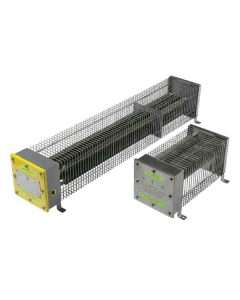
Ex Proof Filter Kit in UAE | Ex Proof Filter Kit Supplier Dubai, UAE
The ATEX AHU Three-Stage Replacement Filter Kit provides a complete filtration package for replacing worn or contaminated filters inside hazardous-area air-handling units. As a dependable Ex Proof Filter Kit in UAE, it combines coarse pre-filtration, fine particulate filtration, and high-efficiency final filtration to help maintain clean airflow and dependable HVAC performance.
The three-stage arrangement captures different particle sizes in sequence. The first filter removes large dust, fibres, insects, and debris. The second stage captures finer airborne contamination, while the final high-efficiency filter controls very small particles that pass through the earlier stages.
Replacing all three stages as one coordinated kit helps restore airflow, pressure balance, filtration efficiency, and indoor air quality. It also reduces the risk of installing incompatible filters with incorrect dimensions, efficiency classes, frame materials, or gasket arrangements.
Atex Hub supplies these ATEX replacement filter kits across the UAE, Saudi Arabia, Qatar, Kuwait, Bahrain, Oman, Europe, Africa, and worldwide for hazardous-area AHUs, ventilation systems, clean-process facilities, offshore installations, and industrial HVAC projects.
What Is an ATEX AHU Three-Stage Replacement Filter Kit?
An ATEX AHU Three-Stage Replacement Filter Kit is a coordinated set of replacement filters designed for an air-handling unit used in a hazardous or industrial environment.
The kit normally contains three filtration stages with different efficiency levels. Each stage removes a specific range of particles and protects the filters installed after it.
The first stage captures large contamination before it enters the deeper sections of the AHU. The second stage removes smaller airborne particles and protects the final filter from rapid loading. The third stage provides high-efficiency filtration where the application requires improved control of fine and ultrafine particles.
Using all three stages together creates a progressive filtration system. This arrangement helps the AHU maintain stable airflow while reducing the dust load placed on the final filter.
The replacement filters can be selected according to the existing AHU dimensions, airflow, operating pressure, hazardous-area assessment, filtration class, frame construction, and process requirements.
Key Features of the Ex Proof Filter Kit
The Ex Proof Filter Kit provides a coordinated filtration solution for maintaining hazardous-area air-handling units.
- Complete three-stage arrangement: Includes coarse, fine, and high-efficiency filtration stages for progressive particle removal.
- Matched filter dimensions: Each filter is selected to suit the existing AHU frame, access section, and filter-retaining system.
- Coarse pre-filtration: The first stage captures larger dust, fibres, lint, insects, and airborne debris.
- Fine particle filtration: The second stage removes smaller dust particles before they reach the final filter.
- High-efficiency final stage: The third filter controls fine or ultrafine particles according to the selected efficiency class.
- Reduced final-filter loading: Pre-filters protect the expensive final stage and help extend its service life.
- Controlled airflow resistance: The filters are selected together to support the required airflow and available fan pressure.
- Antistatic filter options: Conductive or antistatic materials can support correctly assessed hazardous-area systems.
- Multiple frame materials: Galvanised steel, aluminium, stainless steel, plastic, or moisture-resistant board frames can suit different environments.
- Reliable sealing: Gaskets and frame seals help reduce air bypass around the installed filter elements.
- Replacement-ready supply: The kit can include all required filter stages for one AHU maintenance cycle.
- Custom configuration: Filtration classes, dimensions, media, frames, and gaskets can match project requirements.
How the Three-Stage Filtration System Works
Air enters the AHU and first passes through the coarse pre-filter. This stage captures larger particles that could quickly block the finer filters or contaminate internal components.
The partially cleaned air then moves through the second-stage fine filter. This filter removes smaller particles and reduces the dust concentration reaching the final filtration section.
The third-stage filter provides the highest filtration efficiency. Depending on the application, this stage may use a fine compact filter, EPA filter, or HEPA filter.
The progressive arrangement improves overall filter life because each stage protects the next. It also reduces contamination on fans, heating coils, cooling coils, dampers, silencers, and supply-air ductwork.
As filters collect contamination, their resistance increases. Differential-pressure gauges, switches, or transmitters can show when each stage requires inspection or replacement.
Applications of ATEX Replacement Filter Kits
The Hazardous Area Replacement Filter Kit supports air-handling and ventilation systems used across demanding industrial environments.
- Oil and gas facilities: Replaces filters inside AHUs serving process buildings, control rooms, laboratories, workshops, and utility areas.
- Petrochemical plants: Maintains clean supply air in hazardous production areas and chemical-processing facilities.
- Chemical manufacturing: Supports filtration systems exposed to industrial dust, powders, fibres, and process contamination.
- Offshore platforms: Provides replacement filtration for marine HVAC systems operating in corrosive and demanding environments.
- Refineries: Maintains filtration performance in control rooms, electrical rooms, analyser shelters, and occupied buildings.
- Pharmaceutical facilities: Supports multi-stage filtration where controlled particle levels are important for production and packaging areas.
- Food-processing plants: Replaces filters used to protect products, equipment, and working environments from airborne contamination.
- Industrial laboratories: Maintains air quality in testing, sampling, analysis, and controlled work areas.
- Power-generation facilities: Supports AHUs serving turbine buildings, control rooms, workshops, and auxiliary systems.
- Battery manufacturing: Controls fine particulate contamination in production, assembly, and material-handling areas.
- Paint and coating facilities: Captures pigment dust, fibres, and other airborne process contamination.
- Mining and mineral processing: Replaces heavily loaded filters exposed to dust from crushing, conveying, and material handling.
- Marine vessels: Supports filtration for machinery spaces, accommodation areas, and protected technical rooms.
- Hazardous storage facilities: Maintains filtered ventilation in rooms containing chemicals, solvents, and industrial materials.
Technical Specifications
| Specification | Product Details |
|---|
| Product Type | Three-stage AHU replacement filter kit |
| Primary Application | Hazardous-area air-handling and ventilation systems |
| Stage 1 | Coarse pre-filter |
| Stage 2 | Fine particulate filter |
| Stage 3 | High-efficiency final filter |
| Efficiency Options | ISO Coarse, ePM10, ePM2.5, ePM1, EPA or HEPA |
| Filter Construction | Panel, pleated, bag, compact or high-efficiency design |
| Frame Options | Galvanised steel, aluminium, stainless steel, plastic or moisture-resistant board |
| Filter Media | Synthetic, glass-fibre or selected antistatic media |
| Seal Options | Flat gasket, continuous gasket or application-specific sealing |
| Dimensions | Manufactured to match the existing AHU filter section |
| Airflow Capacity | Selected according to AHU airflow and face velocity |
| Pressure Monitoring | Differential-pressure monitoring recommended |
| Hazardous-Area Suitability | Antistatic or conductive configuration according to system assessment |
| Replacement Supply | Individual stages or complete matched kit |
Typical Three-Stage Filter Arrangement
The exact filtration classes should match the AHU design and required indoor air quality.
- Stage 1 – Coarse pre-filter: Captures large dust, fibres, insects, and debris before they enter the AHU.
- Stage 2 – Fine filter: Removes smaller particles and protects the final high-efficiency stage.
- Stage 3 – Final filter: Provides fine, EPA, or HEPA filtration according to the process requirement.
A typical arrangement may combine an ISO Coarse filter, an ISO ePM1 fine filter, and an H13 or H14 HEPA filter. However, the final selection must match the existing system pressure, fan capacity, air-quality target, and AHU construction.
Benefits of Replacing All Three Filter Stages
Replacing the complete filtration set provides several operational advantages.
- Restores airflow: Clean filters reduce unnecessary resistance and help the fan maintain its designed airflow.
- Improves filtration efficiency: A coordinated filter set captures contamination across a wider particle-size range.
- Protects AHU components: Effective pre-filtration reduces dust accumulation on coils, fans, dampers, and silencers.
- Reduces energy waste: Clean filters help prevent excessive fan power caused by high pressure drop.
- Extends final-filter life: Coarse and fine filters reduce the particle load reaching the high-efficiency stage.
- Supports planned maintenance: Complete kits simplify filter ordering, storage, and replacement scheduling.
- Reduces compatibility issues: Matched filters help avoid incorrect sizes, frame depths, gaskets, or efficiency classes.
- Improves indoor air quality: Effective filtration reduces dust and airborne particles entering occupied or controlled areas.
Selection, Installation and Maintenance
Correct filter selection and installation help maintain airflow, filtration efficiency, and hazardous-area safety.
- Record the existing filter dimensions, frame depth, efficiency class, and quantity.
- Confirm the AHU airflow and available fan pressure before selecting higher-efficiency filters.
- Identify the dust type, particle size, moisture level, and process contamination.
- Check whether antistatic or conductive filter materials are required.
- Select corrosion-resistant frames for offshore, marine, chemical, or humid environments.
- Confirm the correct airflow direction before inserting each filter.
- Install the coarsest filter first and the highest-efficiency filter last.
- Check that every gasket forms a continuous seal against the retaining frame.
- Prevent gaps between adjacent filters that could allow unfiltered air to bypass the media.
- Inspect filter clamps, access doors, frames, and seals during replacement.
- Monitor differential pressure across each filtration stage.
- Replace damaged, wet, torn, or heavily loaded filters immediately.
- Do not wash disposable filters unless they are specifically designed for cleaning.
- Record replacement dates and pressure readings for maintenance planning.
- Dispose of contaminated filters according to local environmental and process-safety requirements.
Certifications, Standards and Compliance
The selected filters and complete AHU installation should follow the applicable filtration and hazardous-area requirements.
- ATEX Directive 2014/34/EU – Equipment for Explosive Atmospheres: Covers equipment and protective systems intended for potentially explosive environments.
- ATEX Workplace Directive 1999/92/EC – Worker Protection: Defines minimum safety requirements where explosive atmospheres may occur.
- ISO 16890 – Air Filters for General Ventilation: Classifies filters according to their efficiency against ePM1, ePM2.5, ePM10, and coarse particulate fractions.
- EN 1822 – EPA, HEPA and ULPA Filters: Covers classification and testing of high-efficiency air filters.
- ISO 29463 – High-Efficiency Filters and Filter Media: Defines testing and classification methods for high-efficiency particulate filters.
- EN 15805 – Particulate Air Filters for General Ventilation: Covers dimensions commonly used for filter installation and replacement.
- EN 13053 – Air-Handling Unit Performance: Covers ratings and performance requirements for air-handling units.
- EN 1886 – Mechanical Performance of Air-Handling Units: Covers casing strength, leakage, thermal performance, and related AHU characteristics.
- VDI 6022 – Hygiene Requirements for Ventilation Systems: Addresses hygienic operation, inspection, and maintenance of ventilation equipment.
Why Choose Atex Hub for Replacement Filter Kits?
Atex Hub supplies ATEX replacement filter kits for hazardous-area AHUs, ventilation systems, extraction units, and industrial filtration equipment.
- Supplies Ex Proof Filter Kits across the UAE, Saudi Arabia, Qatar, Kuwait, Bahrain, Oman, Europe, Africa, and worldwide.
- Provides complete coarse, fine, and high-efficiency filter combinations.
- Matches replacement filters to existing AHU dimensions and retaining systems.
- Supports ISO Coarse, ePM10, ePM2.5, ePM1, EPA, and HEPA efficiency classes.
- Offers antistatic and conductive filter options for assessed hazardous-area systems.
- Provides galvanised steel, aluminium, stainless-steel, and alternative frame materials.
- Supports oil and gas, petrochemical, pharmaceutical, food, offshore, marine, and industrial facilities.
- Supplies individual replacement filters or complete maintenance kits.
- Assists with filtration-class, airflow, pressure-drop, frame, media, and gasket selection.
- Supports project documentation, technical submittals, and scheduled replacement requirements.
Frequently Asked Questions
1. What is an ATEX AHU Three-Stage Replacement Filter Kit?
It is a matched set of coarse, fine, and high-efficiency filters used to replace all major filtration stages inside a hazardous-area AHU.
2. Is the Ex Proof Filter Kit suitable for the UAE?
Yes, the Ex Proof Filter Kit in UAE supports correctly assessed industrial AHUs used in refineries, chemical plants, offshore facilities, laboratories, and process buildings.
3. Which filters are included in the kit?
The kit normally contains a coarse pre-filter, fine secondary filter, and high-efficiency final filter.
4. Can the final stage use a HEPA filter?
Yes, the final stage can use an H13 or H14 HEPA filter when the AHU pressure and application support it.
5. Are antistatic filters available?
Yes, suitable antistatic or conductive filter media and frames can support hazardous-area ventilation systems.
6. How are replacement filter sizes selected?
Sizes are matched to the existing AHU filter frames, including width, height, depth, gasket position, and airflow direction.
7. Why should all three stages be replaced together?
A complete replacement helps restore airflow, filtration balance, and protection for downstream AHU components.
8. How can filter loading be monitored?
A differential-pressure gauge, switch, or transmitter can monitor resistance across each filtration stage.
9. Can Atex Hub supply customised filter kits?
Yes, Atex Hub can supply custom replacement kits according to AHU dimensions, filtration class, frame material, and application.
10. Does Atex Hub supply replacement filters worldwide?
Atex Hub supplies ATEX replacement filter kits worldwide, including the GCC, Europe, Africa, and other global industrial markets.
Conclusion
The ATEX AHU Three-Stage Replacement Filter Kit provides a coordinated solution for restoring filtration performance inside hazardous-area air-handling units. Its coarse, fine, and high-efficiency stages capture contamination progressively while protecting the final filter and internal HVAC components.
A complete replacement kit helps restore airflow, reduce pressure drop, improve air quality, and simplify planned maintenance. Custom dimensions, efficiency classes, frame materials, gaskets, and antistatic options allow the kit to match different AHU designs and industrial environments.
For facilities seeking a reliable Ex Proof Filter Kit in UAE, this three-stage solution supports refineries, petrochemical plants, offshore platforms, pharmaceutical facilities, laboratories, and industrial process buildings.
Atex Hub supplies these ATEX replacement filter kits across the UAE, Saudi Arabia, Qatar, Kuwait, Bahrain, Oman, Europe, Africa, and worldwide.